
How to Read a Radon Meter
A radon meter can feel confusing because the display changes.
One moment it says 1.2.
Then it jumps to 6.8.
Then it drops again.
If you interpret the wrong number, you either panic for no reason or ignore a real long-term issue.
Here’s the clean rule:
For decisions, focus on your longer averages (7-day and long-term). “Current” readings are short snapshots and naturally noisy.
Learn more:
radon testing
Learn more:
Quick Answer Box: Which Number Should I Trust?
Most radon meters (continuous monitors) show multiple “views”:
- Current / Now → useful for “what changed today?”
- 24-hour (1-day) average → better, still volatile
- 7-day average → best “practical decision” number
- Long-term average (weeks/months) → best exposure trend and proof over time
If your meter spikes today, don’t react to the spike. Check the 7-day and long-term average.
What Units You’re Seeing: pCi/L vs Bq/m³
Radon meters commonly show:
- pCi/L (U.S. common)
- Bq/m³ (international common)
Many devices let you switch units in settings. If you’re comparing guidance, confirm the unit first.
EPA Decision Anchor (Use Once, Then Move On)
Use this as your action line:
- Fix at 4 pCi/L or higher
- Consider fixing between 2–4 pCi/L
- There is no known safe level
Everything else in this guide is about figuring out where your true average lands.
Before You Read the Numbers: Place the Meter Correctly
Bad placement creates bad readings.
Use these placement rules:
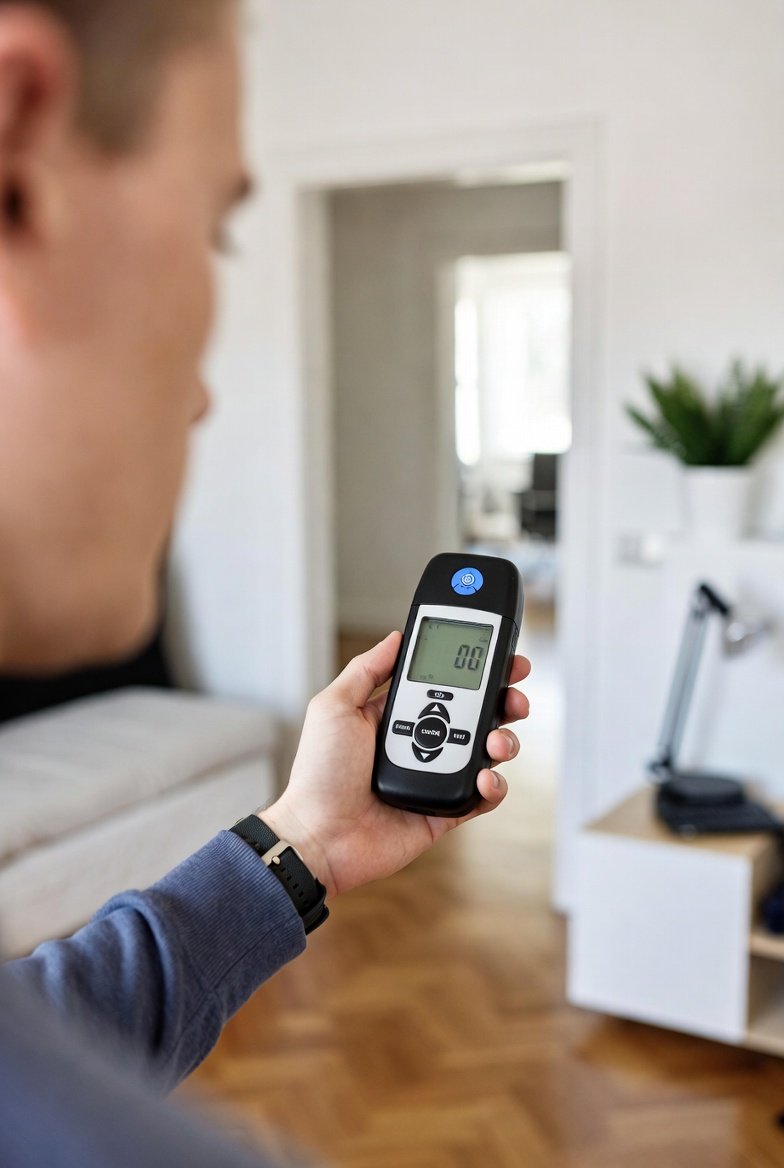
- Put the device on the lowest lived-in level of the home
- Place it in an area occupied 4+ hours per day (don’t measure a room nobody uses)
- Keep it away from drafts, windows, exterior doors, and HVAC vents (air currents distort readings)
- Don’t hide it in a tight closet or dead-air corner unless the manufacturer explicitly recommends it
If your basement is unfinished and never used, you can still screen there—but a “lived-in level” reading may be more meaningful for actual exposure decisions.
Learn more:
Learn more:
what-is-considered-long-term-exposure-to-radon
What You’ll See on Day 1 vs Day 30 (Device Reality)
Many consumer radon meters need time to build stable averages.
Common pattern:
- First day: you mostly see a “current/short” value; it may swing hard
- After ~24 hours: a 1-day average becomes meaningful
- After a week: the 7-day average becomes your best quick decision number
- After ~30 days (on many devices): additional views (like 30-day) and a more stable long-term trend become more reliable
Bottom line: don’t “declare victory” or “declare disaster” off the first 24 hours.
How to Read a Radon Meter Step-by-Step
Step 1 — Identify Which View You’re Looking At
People make one main mistake: they think “current” equals “true.”
Use this operator rule:
- Current/Now: detects changes (weather, ventilation, HVAC)
- 1-day average: still volatile; use for short trend
- 7-day average: best decision number without waiting months
- Long-term average: best exposure trend and post-mitigation proof
Step 2 — Use the 7-Day Average to Decide “Monitor vs Act”
Treat the 7-day average as your decision lane.
If 7-day average is under 2 pCi/L
Low relative concern. Keep monitoring because radon can shift seasonally and after home changes.
If 7-day average is 2–4 pCi/L
This is a “consider reducing” zone. Your next move depends on occupancy (where people sleep), season, and risk tolerance.
If 7-day average is 4+ pCi/L
Treat it as an engineering problem to solve—mitigation planning is reasonable (or confirm with a formal test if needed for a transaction).
Step 3 — Use the Long-Term Average as the Truth Trend
Your long-term average is the value that “survives” weather swings, lifestyle changes, and one-off spikes.
This is the number you watch when you want to know:
- “What is my home doing overall?”
- “Did my mitigation actually hold over time?”
Why Radon Spikes (And Why Spikes Aren’t Your Decision Number)
Radon levels can swing because your house is a pressure system.
Spikes can happen when:
- Outdoor pressure changes
- Temperature changes strengthen the stack effect (often winter)
- HVAC settings change (fan cycling, basement returns)
- Doors/windows are opened for long periods
- Exhaust appliances (dryer, bath fan) change pressure balance
That’s why “current” readings are noisy, and why averages exist.
Decision Path Table: What To Do Based on Your Meter
What your meter shows (use 7-day / long-term) | What it usually means | Best next step |
Under 2 pCi/L | Lower exposure trend | Keep monitoring; retest after major changes |
2–4 pCi/L | Elevated enough to consider reduction | Confirm placement; keep trending; consider mitigation planning |
4+ pCi/L | Action level | Plan mitigation or confirm with a formal test strategy |
Big daily spikes but 7-day stays low | Normal volatility | Ignore spikes; trust averages |
After mitigation: drops then drifts upward | Possible system/pressure change | Verify fan operation; retest; troubleshoot |
Short-Term Testing Rules (Real Estate / Fast Decisions)
If you’re using a short-term radon test (often for a transaction), you must control house conditions.
Closed-house conditions should be maintained at least 12 hours before and during a short-term test.
This is the #1 reason “my numbers don’t make sense” happens during a contract timeline.
If you’re a buyer/seller using a consumer meter, don’t try to game the number. Use the meter to spot trends, then make decisions with compliant testing/mitigation logic.
How to Use a Radon Meter After Mitigation (Proof Mode)
This is where a meter is genuinely powerful.
What “working” looks like on a monitor:
- 1-day average drops first (still noisy)
- 7-day average stabilizes at a lower range
- long-term trend stays lower over weeks/months
Then you confirm with the verification logic on your mitigation page.
Learn more:
Learn more:
Common Mistakes That Create False Confidence
Mistake 1 — Celebrating a low “current” number
A low current reading can happen after ventilation or weather changes. It doesn’t prove your average is low.
Mistake 2 — Panicking at a spike
Spikes happen. Averages are the decision tool.
Mistake 3 — Measuring the wrong space
A basement storage room nobody enters tells you less than a bedroom where someone sleeps 8 hours/night.
Mistake 4 — Ignoring seasonality
Radon can shift with seasons and house pressure changes—longer averages help you see the real baseline.
How Common Is Radon in Homes? (Clean Reality)
Radon is widespread. You can’t reliably predict your home’s level from your neighbor’s result because foundations, soil pathways, and airflow differ house-to-house.
That’s why the correct mindset stays the same:
Measure → interpret → control → verify → monitor.
Key Takeaways
- Use the 7-day and long-term averages for decisions—not the current reading.
- Place the meter on the lowest lived-in level in an occupied area, away from drafts.
- Fix at 4 pCi/L; consider fixing 2–4 pCi/L (EPA).
- For short-term tests, maintain closed-house conditions 12+ hours before and during.
- After mitigation, your meter is proof mode: drop → stabilize → trend.
FAQs
Which number matters most on a radon meter?
For decisions, the 7-day and long-term averages matter most because they smooth normal daily volatility.
Why did my radon meter spike today?
Spikes can come from pressure changes, weather shifts, HVAC behavior, and ventilation. Use averages to judge the real trend.
How long should I wait before trusting a new radon meter?
Wait until it has enough runtime to build stable averages—especially a 7-day average and a longer trend line.
Where should I place a radon meter for the best reading?
Place it on the lowest lived-in level in an occupied area, away from drafts, windows, and exterior doors.
Do I need closed-house conditions when using a radon meter?
For casual long-term monitoring, you want normal living conditions. For short-term tests, closed-house conditions are recommended (12+ hours before and during).