
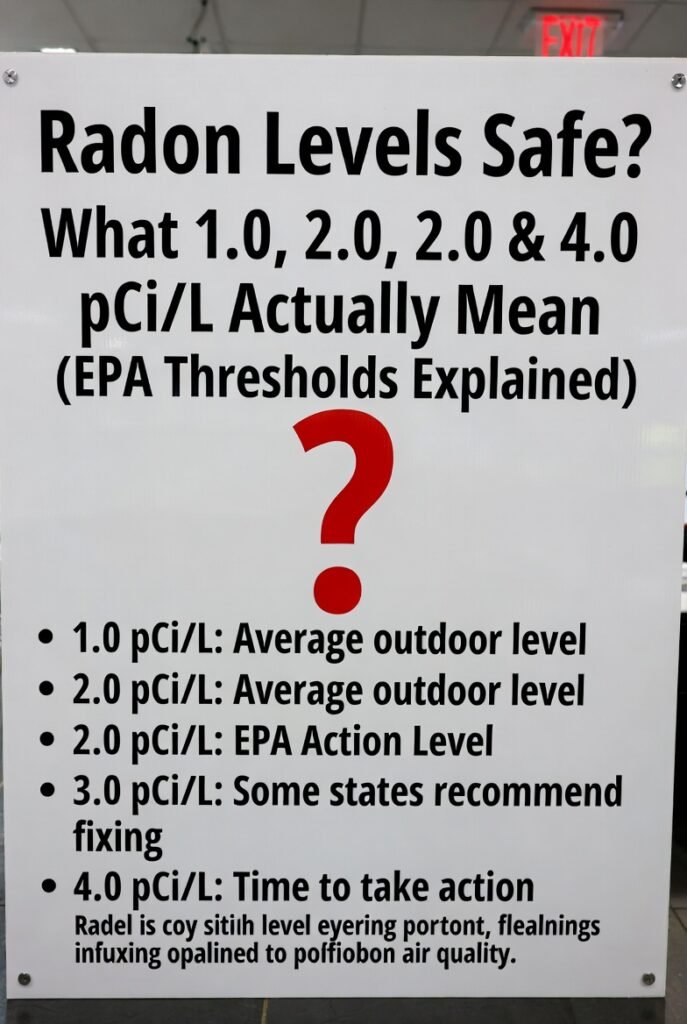
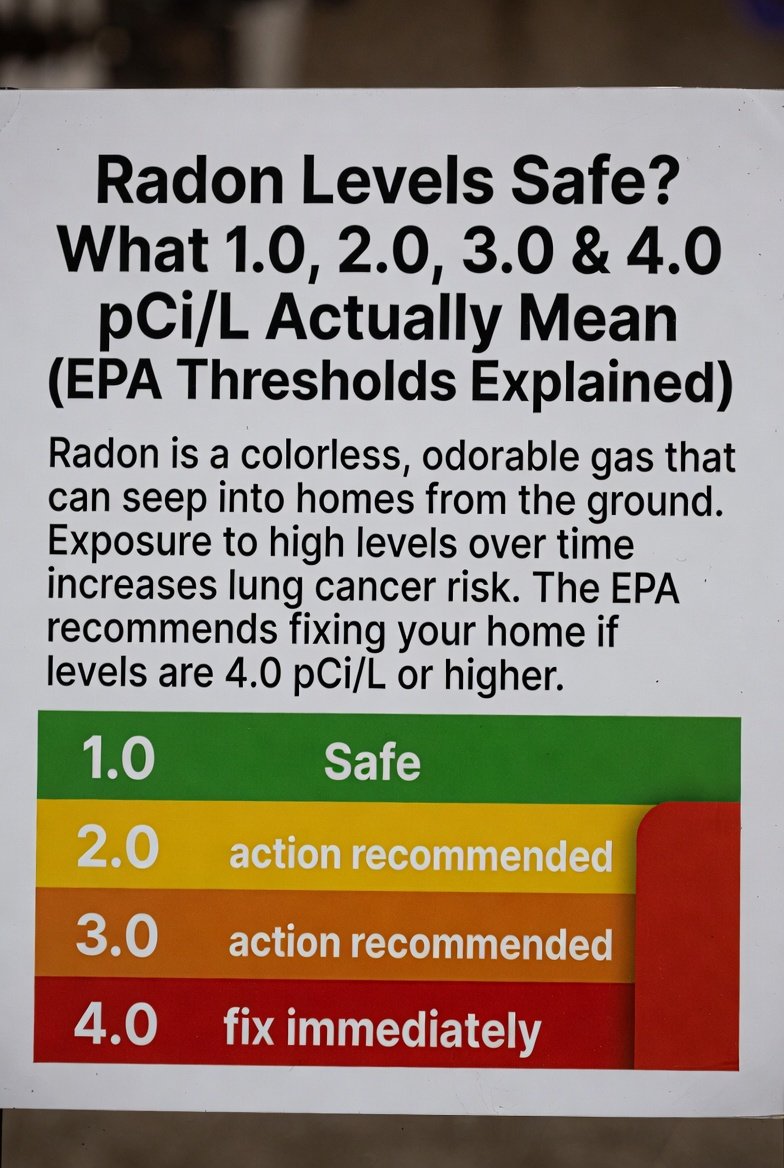
Radon Levels Safe? What the Numbers Actually Mean
Radon is measured in picocuries per liter (pCi/L).
The United States Environmental Protection Agency (EPA) recommends:
- Fixing homes at 4.0 pCi/L or higher
- Considering action between 2.0–4.0 pCi/L
But what does that actually mean for your home?
Is 2.0 safe?
Is 3.5 dangerous?
Is 1.0 zero risk?
This guide explains radon thresholds clearly — without exaggeration and without minimizing risk.
Quick Interpretation Table
Radon Level (pCi/L) | Interpretation | Recommended Action |
Below 1.0 | Very low | Retest every few years |
1.0–2.0 | Low | Monitor; periodic retesting |
2.0–4.0 | Moderate | Consider mitigation, especially if basement is occupied |
4.0 and above | Elevated | Mitigation recommended |
There is no completely “zero-risk” radon level — but risk increases as concentration increases and exposure continues over time.
What Is Considered a Safe Radon Level?
The EPA action level is 4.0 pCi/L.
That does not mean levels below 4.0 are “safe” — it means that risk reduction is strongly recommended at or above that threshold.
Between 2.0–4.0 pCi/L, mitigation is often considered, especially when:
- Basements are used as living space
- Children occupy lower levels
- Long-term exposure is expected
The World Health Organization (WHO) has suggested lower reference levels in some guidance, reflecting that risk exists even below 4.0.
The key idea:
Lower is better — but decisions depend on exposure duration and occupancy.
Is 2.0 pCi/L Safe?
2.0 pCi/L is generally considered low, but not zero risk.
If your reading is:
- 2.0 in an unfinished basement used for storage → monitor
- 2.0 in a finished basement bedroom → consider mitigation
- 2.0 during winter → retest in different season
Context matters more than the number alone.
Is 3.0 pCi/L Dangerous?
3.0 pCi/L falls within the “consider mitigation” range.
It is not classified as an emergency.
However:
- Long-term exposure increases cumulative risk
- Lowering levels closer to 2.0 or below further reduces exposure
If you plan to remain in the home long-term, mitigation may be reasonable even below 4.0.
Why 4.0 pCi/L Is the EPA Action Level
The EPA established 4.0 pCi/L as the action threshold based on risk modeling and practicality.
At or above this level:
- Mitigation is generally recommended
- Reduction is typically achievable with active systems
- Post-install verification confirms effectiveness
More on how mitigation works:
active-radon-mitigation-system
Does “Safe” Depend on Basement Occupancy?
Yes.
Radon typically enters through:
- Basement slabs
- Foundation cracks
- Sump pits
- Utility penetrations
Basements often show higher concentrations than upper floors.
If the basement is:
- Finished living space
- Bedroom or office
- Frequently occupied
Then even moderate readings may justify mitigation.
If you’re evaluating basement-specific costs:
Short-Term vs Long-Term Exposure
Radon risk is cumulative.
Important distinctions:
- A temporary spike is different from a year-long average
- Winter readings may be higher due to closed windows
- Long-term testing gives more accurate exposure assessment
For initial assessment:
radon testing
Seasonal Variability Explained
Radon levels can fluctuate due to:
- Temperature differences (stack effect)
- Closed-home conditions in winter
- Barometric pressure changes
- HVAC operation
A single short-term test is useful — but confirm with additional testing if results are borderline.
There Is No Completely Risk-Free Level
Scientific consensus recognizes:
- Radon is a radioactive gas
- Risk increases with concentration and time
- Lower exposure reduces cumulative risk
However:
- Panic is not warranted at low levels
- Testing and measured decisions are appropriate
This is a risk-management issue — not a crisis signal.
When Should You Retest?
Retesting is recommended:
- Every 2–5 years
- After major renovations
- After mitigation installation
- If occupancy patterns change
If you mitigate, always perform post-install testing to confirm reduction.
Learn how mitigation systems function:
radon-system-installation
Decision Framework: Monitor or Mitigate?
If Your Reading Is:
Below 2.0 pCi/L
→ Retest periodically.
Between 2.0–4.0 pCi/L
→ Consider mitigation if basement is occupied or long-term residence planned.
At or Above 4.0 pCi/L
→ Mitigation generally recommended.
Is Radon Mitigation Worth It Below 4.0?
It can be — depending on:
- Duration of exposure
- Age of occupants
- Use of basement
- Personal risk tolerance
Many homeowners choose mitigation below 4.0 for peace of mind.
Mitigation effectiveness overview:
Common Misconceptions
“1.0 means zero risk.”
No. Risk is reduced, not eliminated.
“3.0 is dangerous immediately.”
Radon risk is long-term, not acute.
“Only basements matter.”
Upper floors may show lower readings but should still be tested if basement levels are elevated.
Final Summary
Radon levels are not classified as simply “safe” or “unsafe.”
They are interpreted on a spectrum.
- Below 2.0 → Low
- 2.0–4.0 → Moderate
- 4.0+ → Action recommended
Lower levels reduce long-term risk.
Testing and verification guide decisions.
Radon is measurable.
Mitigation is measurable.
The goal is reduction — not perfection.
FAQs
What radon level is considered safe?
No level is completely risk-free. Below 2.0 pCi/L is generally considered low, while 4.0 pCi/L is the EPA action level.
Is 3.0 pCi/L dangerous?
It is within the “consider mitigation” range but not an emergency. Long-term exposure context matters.
Should I fix radon at 2.0 pCi/L?
Consider mitigation if the basement is occupied or long-term exposure is expected.
Why is 4.0 pCi/L the action level?
It reflects risk modeling and practical mitigation thresholds established by EPA guidance.
Do radon levels fluctuate?
Yes. Seasonal and ventilation changes can affect readings.
Is radon only a basement problem?
Basements often show higher levels, but upper floors should also be tested if elevated readings are found.
Does mitigation eliminate radon completely?
Mitigation reduces levels significantly but does not eliminate radon entirely.