
Active Radon Mitigation System: When a Fan Is Required (And When Passive Isn’t Enough)
Radon doesn’t move because someone forgot to seal a crack.
It moves because of pressure.
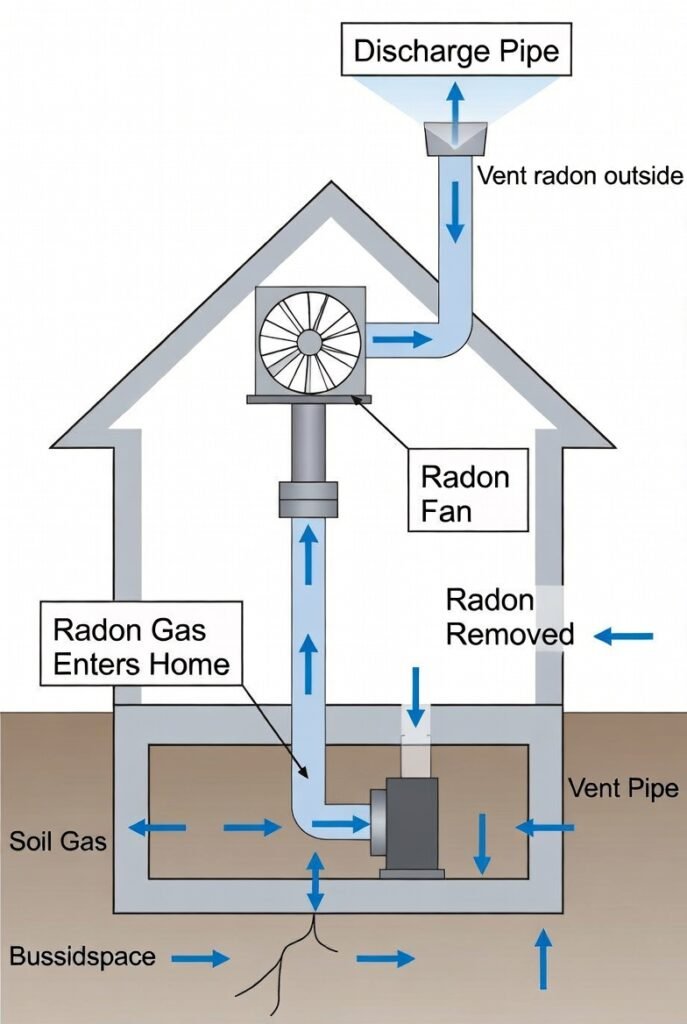
An active radon mitigation system uses a continuously operating fan to create measurable negative pressure beneath your foundation — pulling radon from soil and venting it safely above the roofline.
A passive pipe relies on natural airflow.
An active system controls pressure deliberately.
That difference determines whether radon levels drop reliably — or fluctuate unpredictably.
Quick Verdict
If your home tests at or above 4.0 pCi/L, an active fan-based mitigation system is usually the most reliable solution — followed by post-install testing to verify reduction.
Who This Guide Is For
This guide is for:
- Homeowners with elevated radon levels
- Buyers preparing for inspection or resale
- Owners comparing passive vs active systems
- Anyone deciding whether a fan is necessary
This guide is not for:
- Complex DIY mitigation without pressure diagnostics
- Crawlspace encapsulation design manuals
- Commercial large-building mitigation engineering
What Is an Active Radon Mitigation System?
An active radon mitigation system is a form of Active Soil Depressurization (ASD).
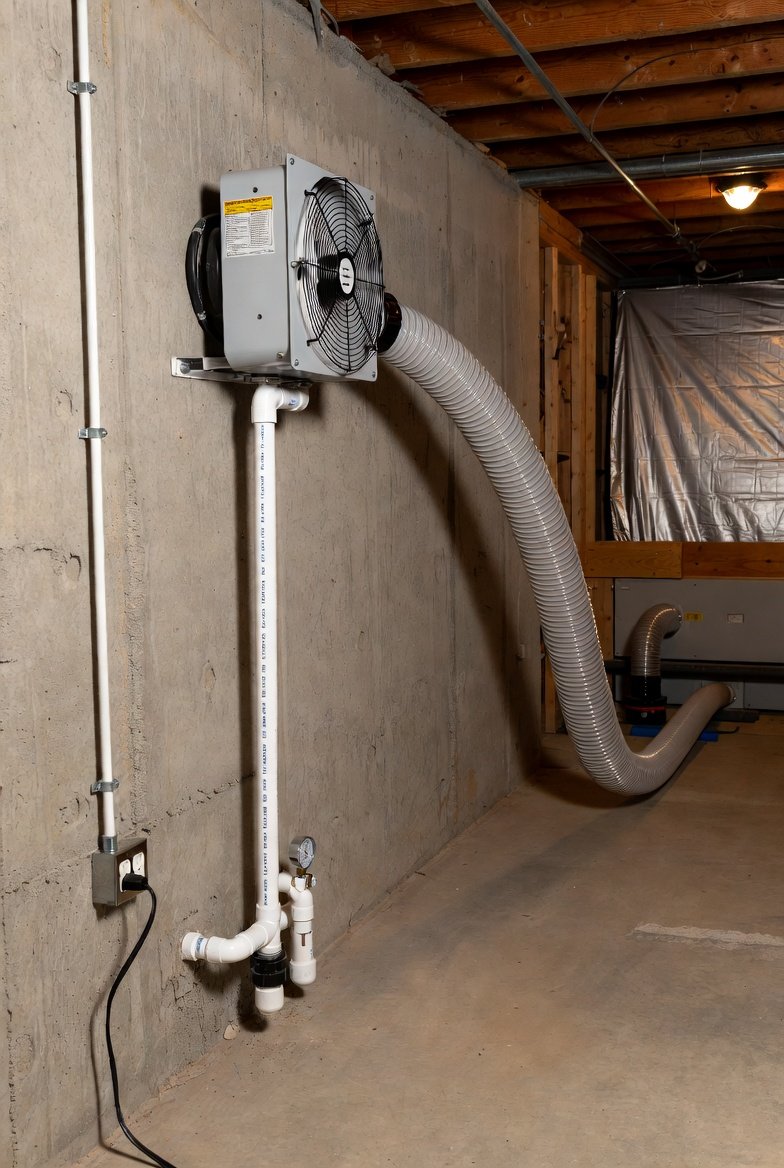
It typically includes:
- Sub-slab suction point
- PVC vent pipe (usually 3″–4″)
- Inline radon fan
- Roof-level discharge
- Manometer (pressure gauge)
The fan continuously pulls soil gas from beneath the foundation and exhausts it outdoors.
For installation fundamentals, see:
radon-system-installation
How an Active System Works (Engineering Principles)
Radon enters homes because indoor air pressure is slightly lower than soil pressure.
An active system:
- Creates stronger negative pressure beneath the slab
- Reverses soil gas flow direction
- Reduces radon entry pathways
Typical targets:
- Pressure differential: 3–5 Pascals
- Fan airflow range: 50–200 CFM depending on soil resistance
Higher airflow alone doesn’t guarantee better performance — static pressure capability matters more.
Radon Pump System (What People Mean)
The term “radon pump system” is commonly used — but technically incorrect.
It is not pumping liquid.
It is moving air.
What matters in a fan:
- CFM at 5 Pa
- Static pressure curve
- Noise rating
- Continuous-duty design
Higher CFM does not always equal better mitigation. Soil resistance determines fan selection.
Active vs Passive Radon Mitigation (Side-by-Side Comparison)
Feature | Active System | Passive System |
Fan | Required | None |
Airflow | Mechanical | Natural convection |
Typical Reduction | 80–99% | Variable |
Performance Stability | High | Dependent on stack effect |
Upgrade Path | Already optimized | Often converted to active |
Recommended ≥4 pCi/L | Yes | No |
Passive systems are often installed in new construction.
Most retrofit mitigation systems are active.
When Passive May Be Acceptable
Passive systems may be considered:
- In new construction with radon-resistant features
- In homes testing below 2 pCi/L
- In regions with low radon prevalence
However, passive systems must still be tested after installation.
If post-build levels exceed recommended thresholds, a fan must be added.
Decision Matrix: Do You Need an Active System?
Radon Level (pCi/L) | Passive Acceptable? | Active Recommended? | Why |
< 2.0 | Usually no mitigation | No | Monitor periodically |
2.0 – 4.0 | Sometimes | Often | Risk exists; depends on soil |
≥ 4.0 | No | Yes | EPA action level |
≥ 10 | No | Yes (urgent) | High exposure zone |
Radon guidance referenced here aligns with recommendations from the U.S. Environmental Protection Agency and international public health authorities based on long-term lung cancer risk modeling.
More on thresholds:
Performance Benchmarks in Real Homes
When properly designed and installed, active systems commonly:
- Reduce radon 80–99%
- Bring levels below 4.0 pCi/L
- Often reduce levels closer to 2.0 pCi/L or lower
Performance depends on:
- Soil permeability
- Foundation design
- Suction pit geometry
- Fan selection
- Sealing effectiveness
Verification is mandatory.
See:
Post-Installation Verification Protocol
A system is not considered complete without testing.
Typical verification steps:
- 24–48 hour stabilization period
- Short-term radon test
- Compare pre-install vs post-install results
- Confirm reduction below action threshold
- Annual retesting recommended
A working fan without a passing test is not proof of performance.
Best System Type by Foundation
Basement Foundations
Most common setup: single or multiple suction points beneath slab.
Active systems standard for elevated radon.
Slab-on-Grade
Often requires precise suction pit placement and routing.
Active systems typical.
Crawlspaces
Sub-membrane depressurization preferred.
Fan draws from beneath sealed vapor barrier.
Common Objections (And Straight Answers)
Is the fan noisy?
Most modern radon fans operate quietly when mounted outside conditioned space.
Will it increase electric bills?
Typically $50–$120 per year depending on fan model.
Is venting near windows dangerous?
Proper installation discharges above roofline per standards to prevent re-entry.
Does it affect HVAC?
No direct connection — system operates independently.
Maintenance & Lifecycle
Radon mitigation is a pressure-control system, not a one-time upgrade.
Lifecycle typically includes:
- Installation
- Post-install testing
- Annual radon retest
- Fan replacement every 7–10 years
Fan failure results in loss of pressure — monitoring via manometer is essential.
Cost Differences: Active vs Passive
Category | Passive | Active |
Pipe materials | $200–$600 | $200–$600 |
Fan | — | $150–$800 |
Installation | Lower | Higher |
Typical Total | $300–$900 | $900–$2,500 |
Full installation cost details:
radon-system-installation
Standards & Professional Guidance
Active soil depressurization is recognized in:
- EPA radon mitigation guidance
- ASTM E2121 mitigation standards
- ANSI/AARST mitigation protocols
These frameworks emphasize pressure control and post-install verification.
Final Verdict
For homes testing at or above recommended action levels, an active radon mitigation system is the most reliable and standards-aligned solution available.
Passive systems are preventive infrastructure.
Active systems are corrective pressure-control systems.
When designed, installed, and verified correctly, active mitigation remains one of the most measurable and consistent indoor air safety interventions available to homeowners.
FAQs
What is an active radon mitigation system?
A system that uses a continuously operating fan to create negative pressure beneath a foundation and vent radon outdoors.
Is a passive radon system enough?
Sometimes in low-level homes, but elevated radon typically requires a fan-based active system.
How effective are active systems?
When properly installed, 80–99% reduction is common.
How long do radon fans last?
Typically 7–10 years.
How much does an active system cost?
Most residential installations range from $900 to $2,500 depending on complexity.
Does an active system increase home value?
Mitigation documentation can improve buyer confidence during resale.
How do I know if my fan is working?
The manometer should show pressure differential; annual testing confirms performance.
Can a passive system be converted?
Yes, most passive systems can be upgraded by adding a fan.