
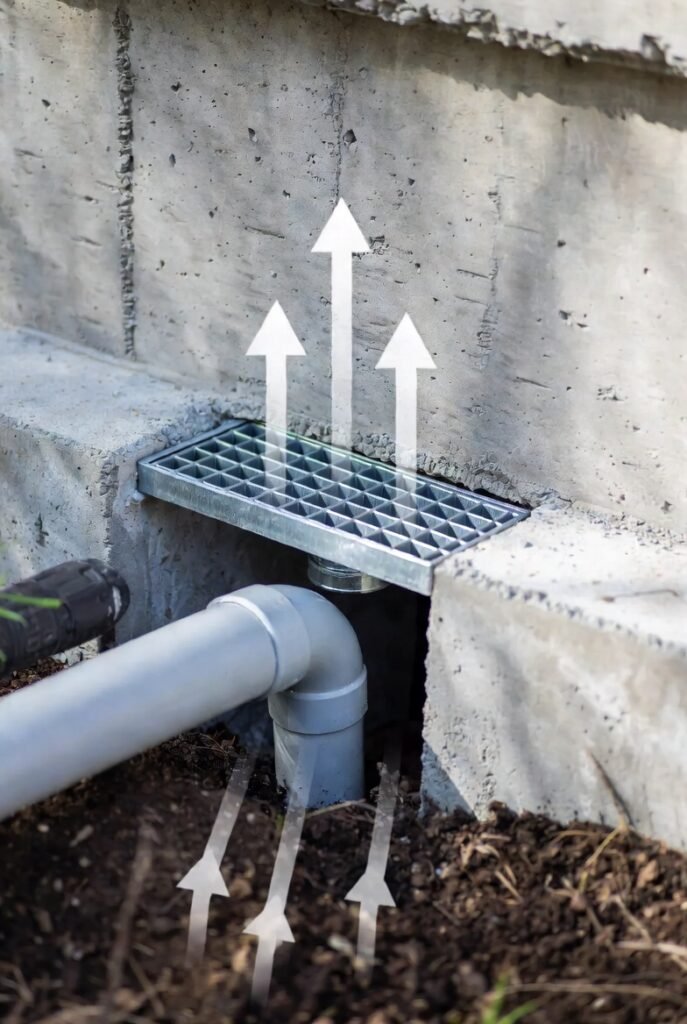
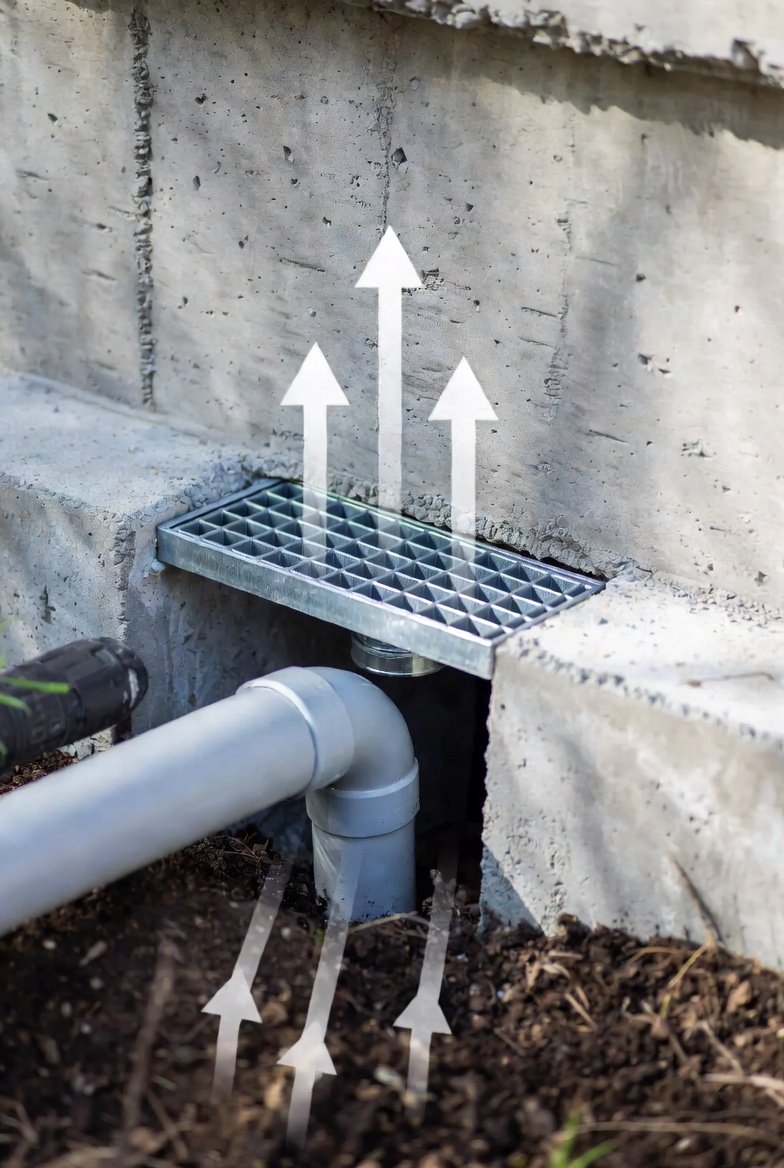
Does Radon Travel Upstairs?
Radon does not “stay in the basement.”
It enters at the lowest level — but it can move upward.
The correct answer is:
Yes, radon can travel upstairs.
In most homes, levels are highest near the foundation and lower as you go up — but airflow patterns determine how much reaches upper floors.
Radon movement is about pressure and air circulation, not gravity alone.
If you haven’t tested yet, start here:
Learn more:
Myth Clarifier: Radon Is Not a “Basement-Only” Gas
Radon is slightly heavier than air — but indoor air mixes continuously.
It does not simply “sit” at the floor.
Warm air rises.
HVAC systems circulate.
Stairwells connect levels.
Air moves. Radon moves with it.
That’s why upstairs levels are often lower — but rarely zero.
How Radon Enters a House
Radon originates in soil.
It enters through:
- Slab cracks
- Control joints
- Sump pits
- Crawlspaces
- Utility penetrations
- Drain lines
The driving force is pressure difference.
Homes operate under slight negative pressure compared to the soil beneath them.
That pressure pulls soil gases inward.
Entry happens low. Distribution depends on airflow.
What Determines Whether Radon Travels Upstairs
1. Stack Effect (Strongest in Winter)
Warm indoor air rises and escapes through upper portions of the home.
As it rises, it pulls replacement air from lower levels — including basement air.
During colder months, stack effect intensifies.
This can increase radon draw and upward distribution.
Season matters.
2. HVAC Circulation
Forced-air systems move air throughout the house.
If the return ducts pull air from the basement, radon-laden air can circulate to upper floors.
Continuous fan mode increases mixing.
3. Open Floor Plans
Open staircases allow vertical air movement.
Closed doors and compartmentalized designs reduce mixing.
4. Basement Usage
Finished basements with active occupancy often have stronger air mixing with upper floors.
Unfinished storage basements may remain more isolated.
Is Radon Usually Higher Downstairs?
Yes.
In most homes:
- Basement: highest
- First floor: lower
- Second floor: lower still
But distribution varies.
In some homes with strong HVAC mixing, levels may be similar across floors.
Testing confirms reality. Assumptions do not.
How Common Is Radon in Homes?
Radon is common.
It is present in all states and regions.
Approximately 1 in 15 U.S. homes test above the EPA action threshold.
Two neighboring homes can test differently due to:
- Foundation type
- Soil permeability
- Construction style
- Air leakage
- Ventilation behavior
Radon presence is common.
Elevated radon is measurable.
Distribution inside the house varies.
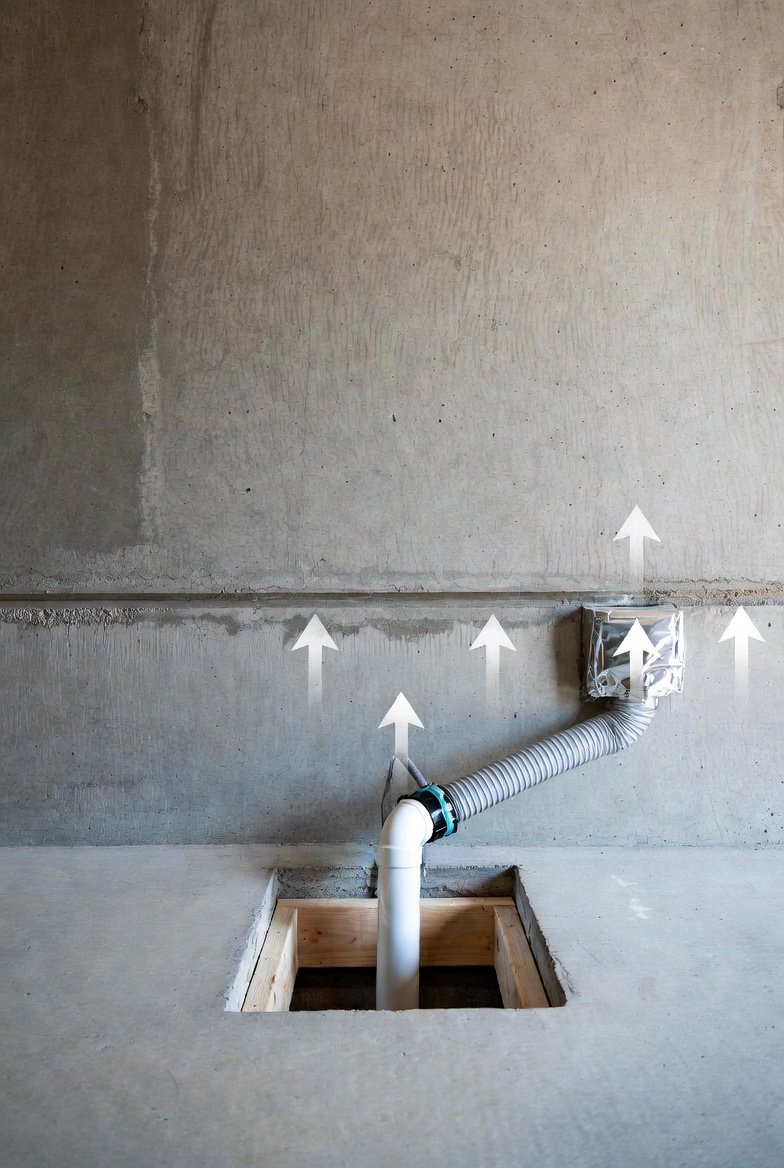
EPA Action Level Anchor
The EPA framework is practical:
- Fix at 4 pCi/L or higher
- Consider fixing between 2–4 pCi/L
- There is no known completely safe level
Testing determines where your home falls.
Comparison Grid: Typical Radon Distribution
Floor Level | Typical Relative Level | Why |
Basement | Highest | Direct soil contact |
First Floor | Moderate | Air mixing from below |
Second Floor | Lower | Dilution + distance from entry point |
Slab Home (no basement) | Ground level highest | Entry through slab |
These are patterns — not guarantees.
Does Sleeping Upstairs Eliminate Risk?
No.
Risk depends on:
- Measured concentration on that level
- Time spent there
- Smoking status
If basement levels are elevated, assume some air mixing occurs.
Exposure risk scales with:
Average concentration × time.
Sleeping location matters.
Occupancy duration matters.
When Upstairs Levels Can Be Similar to Basement
This can occur when:
- HVAC runs continuously
- Basement is finished and open
- Strong stack effect exists
- House has significant air leakage
In these cases, radon distributes more evenly.
This is why upper-floor testing can be useful in some homes.
Testing Strategy for Multi-Story Homes
Step 1 — Test Lowest Lived-In Level
EPA guidance: test the lowest level used regularly.
If basement is occupied → test there.
If no basement → test ground floor.
Step 2 — Interpret Results
Below 2 pCi/L → low relative concern
2–4 pCi/L → consider action
4+ pCi/L → mitigate
Step 3 — If Elevated, Mitigate
Learn more:
radon installation system
Mitigation reduces radon at the source — beneath the slab.
Step 4 — Verify Post-Installation
Mitigation is incomplete without verification.
Post-install testing confirms reduction across the home.
Step 5 — Monitor
Homes change over time.
Weatherization, renovations, and HVAC adjustments can affect pressure balance.
Periodic re-testing maintains clarity.
Learn more:
basement-radon-mitigation-system-cost
Seasonal Variation: Why Levels Change
Radon levels fluctuate due to:
- Winter stack effect
- Closed windows
- HVAC usage
- Soil moisture
- Barometric pressure
Winter often shows higher levels.
Long-term testing smooths seasonal variation and reflects annual average exposure.
House Type Differences
Basement Home
Highest concentration typically at lowest level.
Crawlspace Home
Radon can enter through exposed soil and spread upward.
Slab-On-Grade Home
Entry occurs at slab penetrations; ground floor is primary concern.
Split-Level Home
Airflow complexity may create uneven distribution.
Testing resolves uncertainty.
Radon Does Not “Disappear” Upstairs
Lower concentration does not equal zero exposure.
Radon mixes with indoor air.
If basement levels are elevated, upper floors should not be assumed clear without measurement.
Exposure Logic Summary
Radon:
- Enters low
- Can move upward
- Usually decreases with height
- Is influenced by airflow
- Requires testing for confirmation
Control the source.
Verify reduction.
Monitor periodically.
That is how house-wide exposure is managed.
Key Takeaways
- Yes, radon can travel upstairs.
- Concentration usually decreases with elevation.
- Stack effect and HVAC influence distribution.
- Radon is common in homes nationwide.
- Testing the lowest lived-in level is primary.
- Mitigation reduces radon throughout the home.
- Verification confirms success.
Radon movement is measurable.
Risk management is structured.
Testing removes uncertainty.