
Radon Map by ZIP Code
If you’re searching for a radon map by ZIP code, you’re trying to answer one urgent question:
Is my home in a high-radon area?
Here’s the critical truth for U.S. homeowners:
There is no official nationwide radon map published strictly by ZIP code.
Federal radon maps are based on county-level geologic radon potential, not postal boundaries.
That doesn’t mean you can’t assess your risk.
It means you need to interpret the data correctly.
This guide shows you:
- How EPA radon zones work
- How to check your risk using ZIP → county mapping
- What Zone 1, 2, and 3 actually mean
- Why ZIP-level maps can be misleading
- What action to take next
Learn more:
radon-testing
radon level safe
Is There an Official Radon Map by ZIP Code?
No.
The U.S. Environmental Protection Agency (EPA) publishes a Radon Zone Map by county, not ZIP code.
Why?
Because radon potential is based on:
- Geologic formations
- Soil uranium content
- Rock permeability
- Measured indoor radon surveys
ZIP codes are postal boundaries — they do not reflect geology.
Some third-party websites estimate ZIP-level radon risk by overlaying county data onto ZIP areas. These are approximations.
The authoritative source remains EPA county-based radon zones.
How to Check Radon Risk for Your ZIP Code (Correct Method)
Step 1 — Identify Your County
ZIP codes often cross county lines. Confirm your county first.
Step 2 — Check the EPA Radon Zone Map
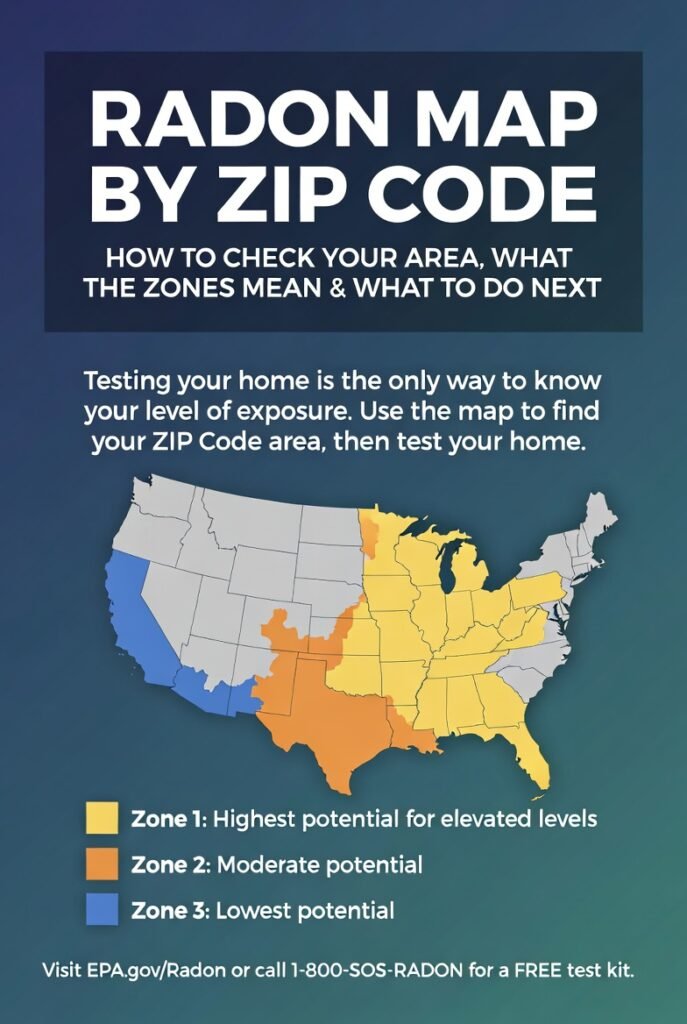
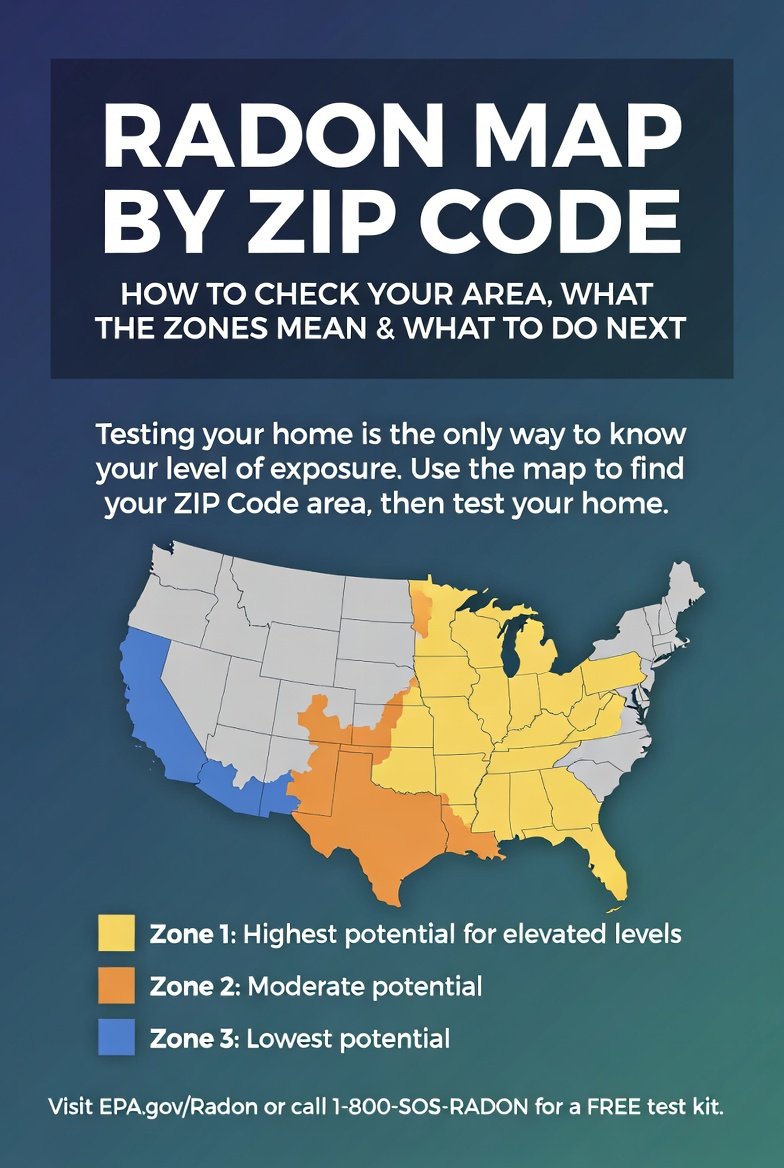
The EPA classifies counties into:
- Zone 1: Predicted average indoor radon > 4 pCi/L
- Zone 2: Predicted average between 2–4 pCi/L
- Zone 3: Predicted average < 2 pCi/L
These zones are based on geologic radon potential combined with measurement data.
Step 3 — Interpret the Zone Properly
The zone predicts probability — not guaranteed indoor levels.
Even Zone 3 counties can contain homes above 4 pCi/L.
EPA Radon Zones Explained (In Practical Terms)
Zone 1 — High Potential
Predicted average indoor radon above 4 pCi/L.
Implication:
- Higher likelihood of elevated levels
- Testing strongly recommended
- Radon-resistant construction common in new builds
Zone 2 — Moderate Potential
Predicted average 2–4 pCi/L.
Implication:
- Moderate probability
- Testing recommended
Zone 3 — Lower Potential
Predicted average below 2 pCi/L.
Implication:
- Lower probability
- Testing still recommended
Notice the pattern:
All zones require testing.
Maps indicate probability. Testing determines reality.
Why ZIP Code Radon Maps Can Mislead
1️⃣ ZIP Codes Cross County Lines
One ZIP can span multiple counties with different radon zones.
2️⃣ Geological Boundaries Don’t Match Postal Boundaries
Radon potential follows rock formations — not ZIP lines.
3️⃣ Counties Contain Mixed Soil Types
Even within the same county, soil permeability varies.
4️⃣ Homes Are Pressure Systems
Foundation type, slab cracks, and HVAC behavior impact radon entry.
That’s why two homes in the same ZIP can show completely different radon levels.
Learn more:
Radon Map vs Radon Test — Critical Comparison
Radon Map | Radon Test |
County-based prediction | Home-specific measurement |
Geological modeling + surveys | Indoor air measurement |
Screening tool | Decision tool |
Indicates probability | Confirms actual exposure |
If your ZIP maps to:
- Zone 1 but your test is 1.8 pCi/L → no mitigation needed
- Zone 3 but your test is 6.1 pCi/L → mitigation recommended
The EPA action level is:
4 pCi/L or higher → mitigation recommended
Real-World Example (How Interpretation Works)
Imagine:
- ZIP 80221 (Denver area) → County classified as Zone 1
- ZIP 77002 (Houston area) → County classified as Zone 2
Does that mean every home in 80221 has high radon?
No.
It means the probability is higher based on geology.
Testing determines the actual number inside your home.
What If Your ZIP Falls in a Zone 3 County?
Zone 3 does not mean “safe.”
It means lower predicted average.
Radon is hyper-local. Homes in Zone 3 counties have exceeded 4 pCi/L.
Skipping testing because of a Zone 3 classification is a mistake.
How Radon Enters Homes (Why Maps Are Limited)
Radon gas enters through:
- Slab cracks
- Control joints
- Sump pits
- Utility penetrations
- Crawlspace soil
Pressure differences inside the home pull soil gas upward.
That’s why mapping can only predict risk — not confirm it.
Data Source & Limitations
EPA radon zones were developed as a screening tool using:
- Geological data
- Indoor radon surveys
- Soil gas potential
They were never designed to:
- Guarantee safety
- Replace testing
- Provide precise ZIP-level resolution
Think of the map as a risk probability layer, not a diagnosis.
What to Do Based on Your Radon Zone
Zone | Probability Level | Recommended Action |
Zone 1 | Higher | Test immediately |
Zone 2 | Moderate | Test |
Zone 3 | Lower | Test |
Testing is the universal recommendation.
Learn more:
how-to-read-radon-meter
Buying or Selling a Home?
Radon maps do not replace:
- A short-term test during a transaction
- A long-term confirmation test
- A post-mitigation verification test
If your county is Zone 1, testing is especially important during real estate transactions.
Common Misconceptions
❌ “Zone 3 means no radon.”
False.
❌ “Zone 1 guarantees high radon.”
False.
❌ “My neighbor tested low, so I’m safe.”
Incorrect.
Radon varies home to home.
The Complete Radon Risk Cycle
- Check your county’s radon zone
- Use it as probability context
- Test your home
- Compare results to EPA action level
- Mitigate if needed
- Retest to confirm
That is the only reliable process.
Key Takeaways
- There is no official national ZIP-code radon map.
- EPA radon zones are county-based and predictive.
- Zones indicate probability — not guaranteed indoor levels.
- Radon varies house to house.
- Testing is the only way to confirm exposure.
FAQs
Is there a radon map by ZIP code?
No official nationwide ZIP-based radon map exists. Most radon maps are county-based and show potential risk zones.
How do I check radon risk for my ZIP code?
Identify your county and check the EPA radon zone classification for that county.
If my ZIP code is Zone 3, am I safe?
No. Zone 3 indicates lower probability, but homes can still exceed 4 pCi/L.
Does a radon map replace testing?
No. Maps show predicted risk. Only testing confirms indoor levels.
What is the EPA action level?
Mitigation is recommended at 4 pCi/L or higher.