
Radon System Installation: What Makes It Work (And What Makes It Fail)
Radon mitigation isn’t a “home upgrade.” It’s a pressure-control safety system.
Radon forms naturally in soil and rock, then moves into buildings through cracks, joints, sump pits, and penetrations. It’s invisible and odorless, and long-term exposure increases lung cancer risk.
A proper radon system installation changes the pressure relationship between your home and the soil beneath it. Instead of soil gases being pulled into your living space, the system creates a controlled negative pressure zone under the foundation and vents those gases safely outdoors.
Done right, most homes see large reductions; done wrong, you get a small drop that looks reassuring but can still leave you above recommended thresholds.
Who This Guide Is For
- Homeowners comparing professional installation quotes
- Buyers/sellers preparing for inspection
- Anyone verifying an existing system’s performance
- Homeowners with results at/above action levels deciding what to do next
Who This Is Not For
This is not a step-by-step DIY blueprint for high-radon homes, crawlspaces, or complex foundations without pressure diagnostics and post-install verification.
Radon Action Levels (EPA + WHO Context)
Radon Level (pCi/L) | What to Do |
0–2 | Retest periodically (and after major renovations) |
2–4 | Strongly consider fixing—EPA notes risk exists even below 4 |
4+ | Fix the home (EPA recommended action level) |
10+ | High priority—don’t delay mitigation |
20+ | Urgent—mitigate and verify fast |
EPA recommends fixing homes at 4 pCi/L or higher and also considering action between 2 and 4 pCi/L.
WHO’s radon health guidance and “reference levels” are often discussed around 100 Bq/m³ (≈ 2.7 pCi/L) in international programs and research context.
Internal support:
what-is-considered-long-term-exposure-to-radon
Terminology Quick Reference (LSI Table)
Term | Meaning | Why It Matters |
Pa (Pascals) | Pressure measurement | ASD systems are pressure systems |
CFM | Airflow rate (cubic feet/min) | Fan performance + soil resistance |
Static Pressure | Resistance the fan must overcome | Clay soils + long runs need higher “pull” |
ASD | Active Soil Depressurization | The most common mitigation approach |
NRPP | National Radon Proficiency Program | Credentialing + professional lookup |
How Radon System Installation Works (Engineering Model)
Most professional systems use Active Soil Depressurization (ASD)—commonly called sub-slab depressurization.
The goal: create a negative pressure field beneath the slab that’s stronger than the pressure inside your home. That reverses the flow path so soil gas is captured under the foundation and vented outside.
Two practical realities decide performance:
- Soil permeability: gravel spreads suction well; dense clay resists airflow
- System resistance: pipe length, elbows, routing, and vertical lift add friction and backpressure
Pressure field illustration:
radon-mitigation-system-diagram
Radon System Installation Step-by-Step (Professional Standard)
1) Pre-Assessment (The Step That Prevents Underbuilt Systems)
A qualified installer should confirm:
- Foundation type (basement, slab-on-grade, crawlspace)
- Likely entry points (sump pit, cove joint, slab cracks)
- Pipe routing plan (short + vertical when possible)
- Electrical access for a continuous-duty fan
- Whether drain tile can be used as a suction field (where applicable)
Internal support:
2) Slab Penetration + Suction Pit
Typical approach:
- Core drill a 4–6 inch hole through the slab
- Excavate a suction pit beneath the slab (often ~10–20 inches across depending on soil)
- Backfill with clean gravel to improve airflow
- Seal the penetration area with a durable sealant
Field truth: suction pit quality is one of the biggest “silent” differences between systems that drop levels dramatically vs. systems that barely move the needle.
3) Pipe Routing (Where Many Systems Lose Efficiency)
Common best practices:
- 3″–4″ Schedule 40 PVC
- Minimize long horizontal runs
- Use gentle transitions instead of multiple tight 90° turns
- Maintain a slight slope where condensation could form
- Keep the system simple: fewer elbows, fewer problems
Discharge termination: above the roofline and away from openings to prevent re-entrainment (many installers follow local code + recognized standards referenced by credentialing bodies).
4) Fan Placement + Electrical
The fan should be:
- Continuous-duty
- Installed outside living space (exterior, attic, garage)
- Positioned to reduce risk from any pipe leaks (leaks should not vent into lived areas)
Fan placement affects:
- Noise (exterior is usually quieter indoors)
- Condensation behavior (routing + slope matters)
- Serviceability (easy access = better long-term upkeep)
5) Sealing + Sump Covers (Efficiency Boost, Not the Whole Solution)
Sealing helps the system hold pressure by reducing leakage.
Common sealing targets:
- Sump pit (use an airtight lid designed for radon where needed)
- Floor-wall joint / cove joint gaps
- Utility penetrations
- Visible cracks and control joints
Manometer Target: Your “Green Zone” Check
Most radon systems include a U-tube manometer (or digital indicator) to show the system is drawing suction.
Simple homeowner rule:
- Visible difference = system is pulling
- No difference / zero reading = treat as a failure and investigate
U-tube “green zone” visual guideline: many homeowners see normal operating differentials in a range like ~0.5–1.5 inches of water column, but what matters most is your system’s normal baseline—any big change is a reason to investigate.
Radon System Installation Cost (Realistic Ranges)
Costs vary by foundation type, routing complexity, and region.
A few published consumer sources show typical installed ranges:
- HomeAdvisor reports a typical installed cost range for radon mitigation with averages around ~$1,000 in many homes.
- University/extension guidance often cites ~$900–$3,000 as a realistic range depending on complexity.
- Many contractors quote $800–$2,500 for straightforward installs.
Cost Table (Practical Breakdown)
Component | Typical Range | What Drives It |
Fan + fittings | $150–$800 | Performance class, brand, noise profile |
PVC + routing materials | $100–$450 | Pipe length, elbows, roof/sidewall exit |
Labor | $700–$1,800 | Routing complexity, foundation type |
Electrical | $150–$450 | Outlet, wiring access, code requirements |
Post-install test | $100–$250 | Short-term lab kit or pro measurement |
Fast reality check: a simple unfinished basement with easy routing is often near the lower-middle range; crawlspaces and multi-point suction designs trend higher.
Internal support:
basement-radon-mitigation-system-cost
Branded Fan Table (Buyer-Friendly, Not Spammy)
Use this like a comparison reference when you’re reviewing bids or replacing a fan. (Exact performance depends on the system curve and soil resistance.)
Fan Model | Approx. CFM @ 5 Pa | Typical Price | Buy |
Festa RVP165 | ~165 | ~$220–$260 | Amazon (search model) |
RadonAway RP145 | ~145 | ~$200–$240 | Home Depot (search model) |
PNI RAMRadon | ~140 | ~$170–$210 | Affiliate/retail (search model) |
Buyer note: don’t pick a fan on CFM alone—static pressure performance and your home’s resistance profile matter more than raw airflow numbers.
Cost Calculator Embed (On-Page Conversion Asset)
Enter ZIP + Foundation → Instant Cost Estimate
If you want a simple on-page estimator, the fields that convert best:
- Square footage (range dropdown is fine)
- Foundation (Basement / Slab / Crawlspace)
- Region (Northeast, South, Midwest, West or “High-cost metro”)
- Optional toggles: Finished basement? Multiple suction points?
Example outputs (range-based):
- Basement, 1,500–2,500 sq ft, Midwest → $900–$1,600
- Slab, 1,500–2,500 sq ft, West/high-cost metro → $1,300–$2,200
- Crawlspace + membrane work → $1,800–$3,500+ (varies widely)
Rebates & Assistance Programs
Programs vary heavily by state, county, and sometimes by utility district.
What’s consistently true:
- Some states provide assistance or grant programs for mitigation in high-radon areas
- Some utilities occasionally run indoor air safety or home improvement rebates
- Real estate transactions sometimes include credits negotiated at inspection
Best move: check your state radon office and local utility rebate pages before you install. (If you’re publishing local pages later, this is a strong city/state add-on section.)
State Permit / Code Snapshot (Practical Expectation Setting)
Rules differ by municipality, but here’s the buyer-facing reality:
State | Permit | Common Requirement (Examples) |
CA | Often Yes | Pipe sizing + routing requirements vary by jurisdiction |
TX | Often No | Manometer/indicator commonly expected |
NY | Often Yes | Certified mitigator commonly required in many areas |
MN | Often Yes | Strong radon program; licensing/certification common |
Rule: always confirm with your local building department (this avoids inspection headaches on resale).
System Lifecycle (This Is Why Pros Beat DIY)
A radon system isn’t “install and forget.” It’s an asset with a lifecycle:
- Initial testing (baseline)
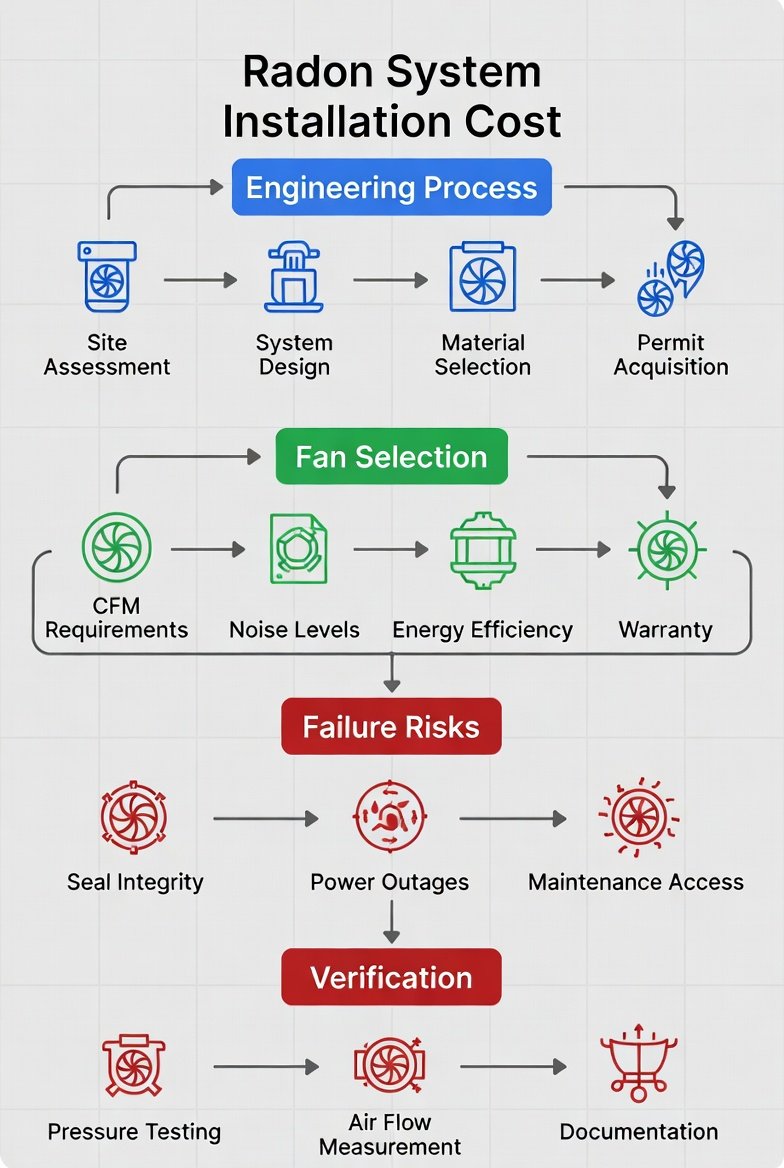
- Design + fan selection (match soil + routing resistance)
- Installation (suction pit + routing quality)
- Verification (post-install test)
- Ongoing monitoring (manometer + periodic retesting)
- Fan replacement (commonly 7–10 years)
- Re-optimization after renovations or foundation changes
This “lifecycle framing” is a major trust signal in a YMYL category.
If Post-Install Levels Stay High (Diagnostics Micro-Block)
If your post-install test is still elevated:
- Increase suction pit size (improve sub-slab communication)
- Upgrade to a fan with higher static-pressure capability
- Add a secondary suction point (common on large footprints or slabs)
- Reduce routing resistance (unnecessary elbows/long horizontals)
- Inspect for major bypass pathways (sump lids, large slab gaps)
Internal support:
Find a Certified Installer (NRPP + EPA Guidance)
EPA guidance for finding qualified providers references programs such as NRPP, and NRPP provides a professional search tool.
NRPP pro search:
(For your lead-gen pages later: “Enter ZIP → get 3 quotes” is the highest-converting module—keep it near the end and once mid-article.)
Resale & Inspection Impact (What Actually Matters)
Even when buyers don’t “care” about radon emotionally, inspection processes force the issue.
A documented mitigation system helps you:
- Avoid last-minute negotiation pressure
- Show measurable improvement via test results
- Reduce buyer uncertainty (and buyer uncertainty kills deals)
If you’re selling a home, always keep:
- Your post-install test results
- Installer invoice / warranty
- Any permit documentation
Is Radon System Installation Worth It?
If your radon level is at or above the EPA action level (4 pCi/L), mitigation is one of the most measurable indoor-air interventions you can do.
When designed, installed, and verified correctly, radon mitigation is one of the most reliable and measurable indoor air safety interventions available to homeowners.
FAQs (12)
1) How long does radon system installation take?
Most straightforward installs take about half a day, with complex routing or crawlspace membrane work taking longer.
2) How effective are radon mitigation systems?
Many systems reduce radon substantially; performance depends on soil resistance and correct design. EPA notes most homes can be reduced significantly with today’s methods.
3) Do I need a permit?
Sometimes—depends on your municipality. Always check local requirements.
4) How often should I retest?
Retest after installation and periodically afterward, especially after major renovations.
5) Is the fan loud?
Usually a low hum. Exterior placement generally reduces indoor noise.
6) How long does a radon fan last?
Commonly 7–10 years, depending on model and operating conditions.
7) Does homeowners insurance cover mitigation?
Usually not. Some inspection negotiations result in credits instead.
8) Can one system cover multiple foundation areas?
Sometimes—large footprints or mixed foundations often need multiple suction points.
9) What warranty is normal?
Workmanship warranties vary; many installers offer multi-year warranties plus fan manufacturer warranty.
10) How do I verify NRPP certification?
Use NRPP’s pro search tool to confirm credentials.
11) What are warranty red flags?
No post-install test requirement, no fan model transparency, or vague performance promises.
12) Does radon mitigation also fix moisture or mold?
It can improve sub-slab air movement, but it’s not a moisture control system—treat mold/moisture as its own problem.