
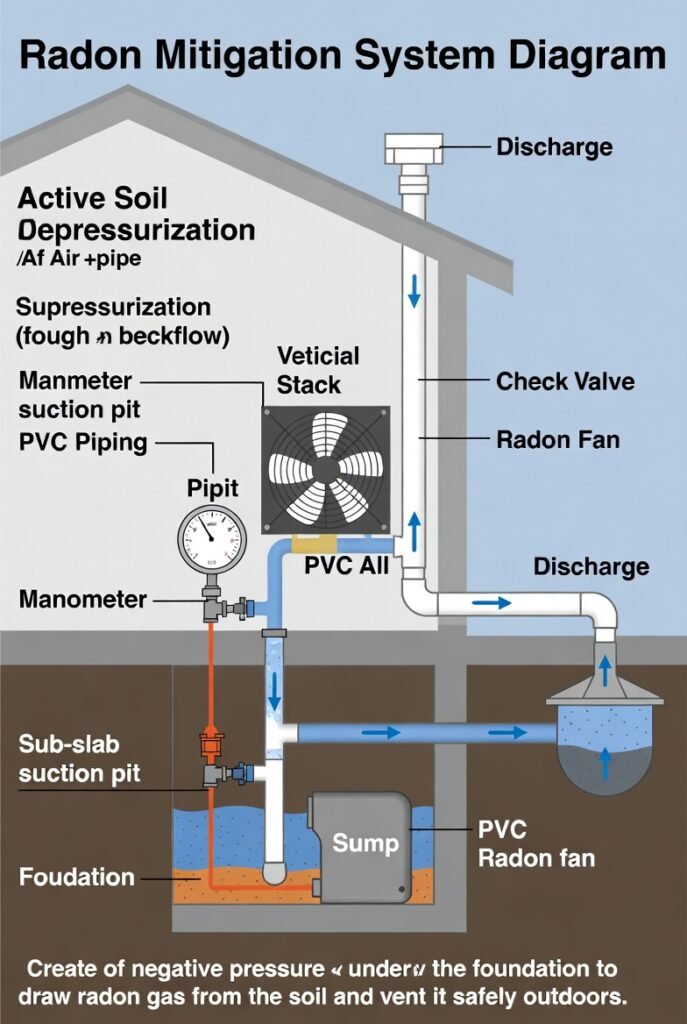
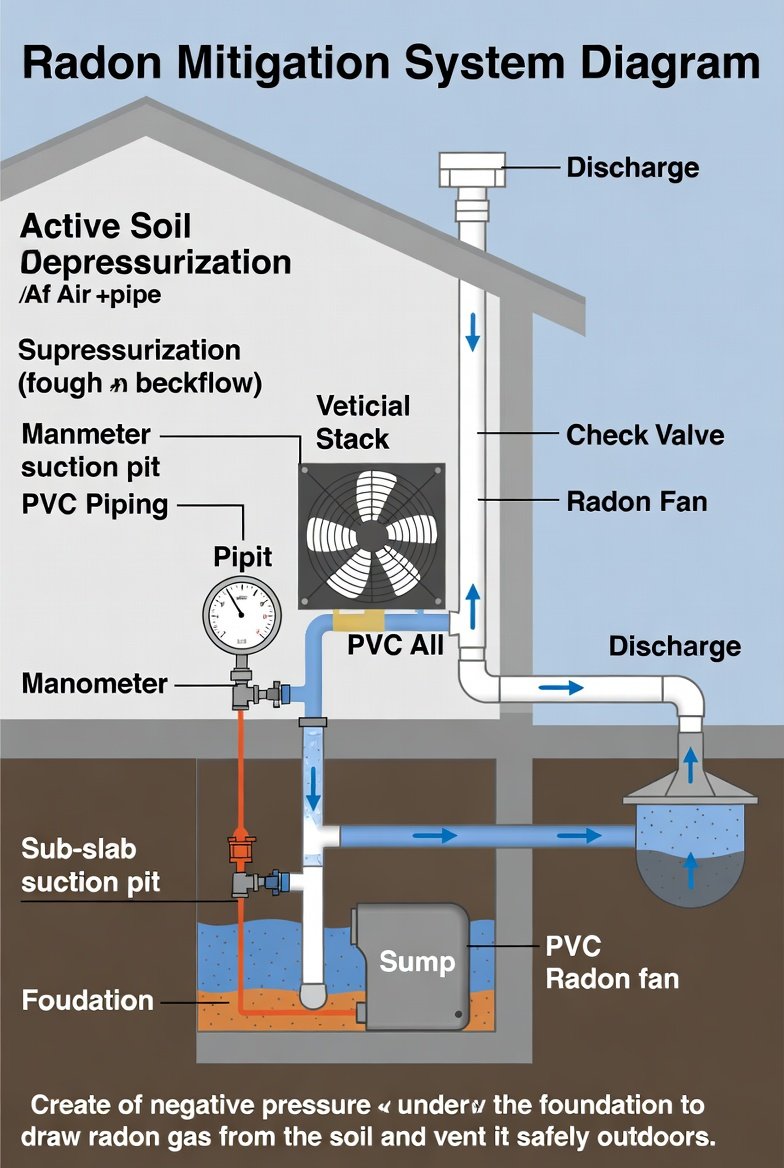
Radon Mitigation System Diagram
A radon mitigation system usually looks simple:
A vertical white PVC pipe.
A small fan somewhere along that pipe.
A gauge mounted on the pipe.
But behind that simple appearance is a pressure-control system designed to pull radon gas from beneath the foundation and safely vent it outdoors.
Most modern systems use Active Sub-Slab Depressurization (SSD/ASD) — the most common and proven configuration for existing homes.
Master Diagram — Standard Active Sub-Slab Depressurization (SSD)
Cross-Section Layout (Foundation View)
Soil under slab
→ Suction pit / suction point
→ PVC riser pipe
→ Inline radon fan
→ Vertical vent stack
→ Roof discharge point
Diagram Legend (Numbered Components)
1) Suction Pit (Under Slab)
A small cavity created beneath the slab to allow soil gas to be drawn evenly.
2) Suction Pipe (PVC Riser)
Carries soil gas from beneath the slab upward.
3) Radon Fan
Creates continuous negative pressure beneath the slab.
4) Vent Stack
Transports radon gas vertically to the discharge point.
5) Manometer (U-Tube Gauge)
Shows that suction is being created.
It does not measure radon levels.
6) Roof Discharge Point
Releases radon safely above the home.
7) Sealed Sump Cover (if applicable)
Prevents air leaks that would reduce system efficiency.
8) Slab Crack Sealing
Improves suction field effectiveness (supports the system — does not replace it).
What a Radon Mitigation System Looks Like in a Real Home
In most homes, you’ll see:
- A 3–4 inch PVC pipe starting near a basement wall or sump area
- A vertical run through utility spaces or closets
- A fan located in an attic, garage, or exterior run
- A manometer mounted on the pipe in the basement
- A vent pipe exiting above the roofline
If you see plumbing stacks, don’t confuse them with radon pipes. Radon pipes are usually labeled and connect to a visible fan system.
Fan Location Rules (Critical)
A radon fan should not be installed in or below conditioned living space.
Typical correct placements:
- Attic
- Garage
- Exterior pipe run
- Utility area outside main living zones
Improper placement inside livable space increases risk if leaks occur.
Radon Discharge Clearance Rules (What to Check)
A properly installed discharge pipe should:
- Terminate above the roofline
- Be routed away from windows and openings
- Not discharge below eaves or soffits
- Not vent into a garage
- Not end below windows or near air intakes
The purpose is to prevent re-entry of radon into the home.
Diagram Variation 1 — Basement + Sump System
Some systems use a sump pit as the suction location.
What it looks like:
- Sealed sump cover
- Pipe connected to sump lid
- Fan + vertical discharge
Why sealing matters:
Open sump lids reduce pressure control and weaken system performance.
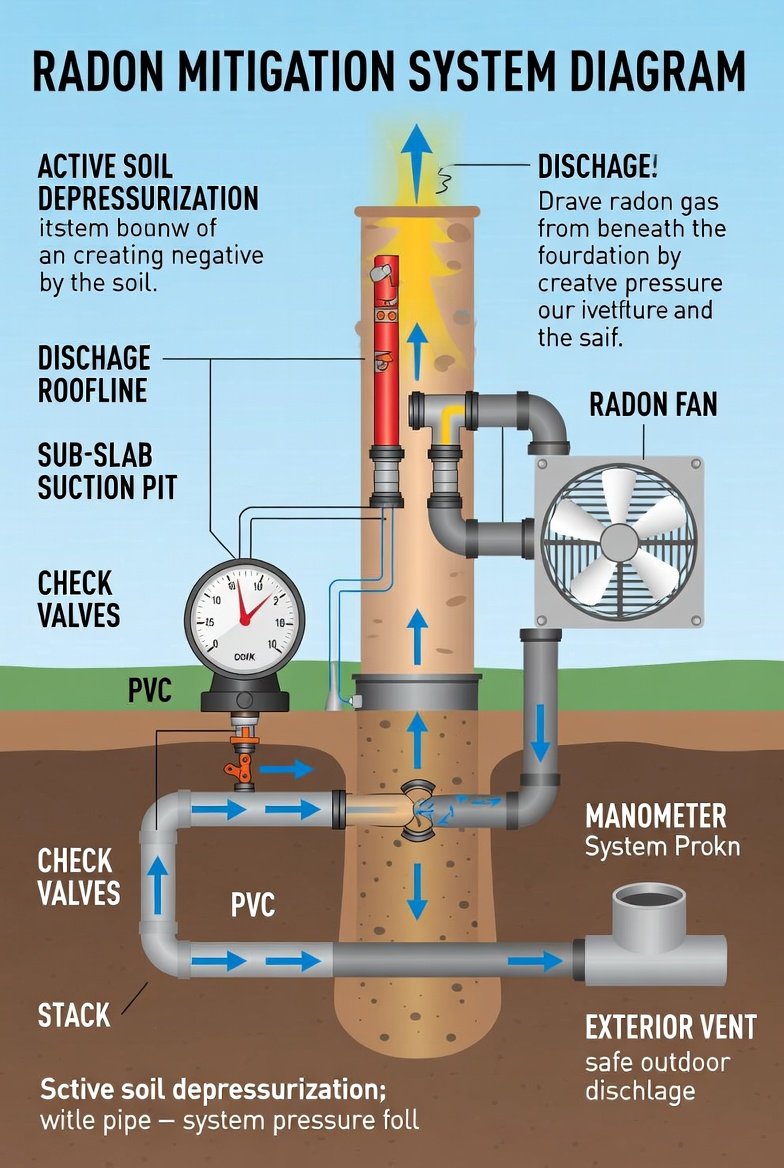
Diagram Variation 2 — Exterior Fan System
Some homes use exterior fan mounting.
What you’ll see:
- PVC pipe mounted on outside wall
- Fan mid-run
- Pipe continuing upward above roofline
Pros:
- Keeps noise outside
- Keeps fan outside conditioned air
Consideration:
- Exterior routing must manage weather exposure and condensation.
Diagram Variation 3 — Crawlspace Mitigation System
Crawlspace systems look different.
Instead of pulling air directly from beneath a slab, they:
- Install a heavy plastic membrane across crawlspace soil
- Seal seams and edges
- Pull air from beneath the membrane
- Vent using fan + pipe system
Visual identifiers:
- White or clear membrane covering soil
- Sealed foundation walls
- Vertical vent pipe connected to membrane area
Passive vs Active Radon Systems (Visual Comparison)
Passive System (Common in New Construction)
- PVC pipe from slab
- No fan
- Relies on natural stack effect
Looks like:
Just a pipe — no fan, no manometer.
Active System (Most Existing Homes)
- Same pipe
- Fan installed inline
- Manometer present
- Continuous suction
If you see a fan and gauge, it’s active.
Good Install vs Red Flag Checklist
✅ Signs of a Proper System
- Fan outside living space
- Pipe clearly labeled
- Manometer fluid offset
- Sump lid sealed
- Discharge above roofline
- System retested after install
❌ Red Flags
- Fan inside basement living area
- No manometer
- Pipe ends below window
- Sump uncovered
- Pipe discharges under eaves
- No post-install testing
What the Manometer Should Look Like
A U-tube gauge contains colored fluid.
Normal:
- Fluid levels are uneven (offset)
If both sides are equal:
- Fan may not be operating
- System may have failed
The manometer does not show radon levels — it only confirms suction.
To check actual radon levels:
how-to-read-radon-meter
Verification: The Proof Step
A mitigation system is not “complete” until testing confirms reduction.
After installation:
- Conduct a radon test
- Confirm levels are below the EPA action level (4 pCi/L)
- Monitor periodically (every 2 years or after major remodeling)
Learn more:
/does-radon-mitigation-work
Why Some Systems Underperform
If radon remains elevated:
- Suction pit placement may be insufficient
- Foundation may require multiple suction points
- Fan may be undersized
- Foundation additions may require extended piping
What you might see visually:
- Additional suction points added
- Larger fan installed
- Extra sealing performed
Mitigation is engineering, not decoration.
How to Identify If Your Home Already Has a System
Look for:
- 3–4 inch PVC pipe in basement
- U-tube gauge attached
- Inline fan unit (attic/garage/exterior)
- Pipe labeled “Radon Reduction System”
- Roof vent pipe separate from plumbing vent
If those exist, your home likely has an active system.
Key Takeaways
- The most common system is active sub-slab depressurization.
- A radon system is a pressure control system — not a filtration device.
- The manometer shows suction, not radon levels.
- Discharge must be above the roofline and away from openings.
- Retesting confirms performance.
FAQs
What does a radon mitigation system look like?
Typically a vertical PVC pipe connected to a fan, with a manometer gauge on the pipe and a discharge above the roofline.
Where is the radon fan usually located?
Usually in the attic, garage, or exterior pipe run — not inside livable space.
Is the manometer showing my radon level?
No. It shows suction pressure only. Radon levels require testing.
What if my system has no fan?
It may be a passive system. Passive systems rely on natural airflow and may require activation with a fan if radon remains elevated.
Do I need to test after installation?
Yes. Retesting confirms the system is functioning properly and achieving reduction.