
Indoor Air Quality and HVAC Systems: How They Interact—and Where They Don’t
Introduction: Why HVAC and Air Quality Are Often Confused
- Indoor air quality (IAQ) and HVAC systems are closely connected—but not the same
- HVAC systems:
- Move air
- Heat and cool it
- Filter it
- Distribute it through a space
- Indoor air quality is shaped by:
- What’s in the air
- Where it comes from
- How conditions change over time
- When something feels “off,” HVAC is often blamed first
- In many cases:
- HVAC is only part of the picture
- Not the root cause
- This page explains:
- How HVAC influences IAQ
- When HVAC is genuinely involved
- When air quality issues come from elsewhere
- How to avoid turning every air concern into a mechanical problem
The Core Relationship Between HVAC and Indoor Air Quality
- HVAC systems influence IAQ through air movement and conditioning
- They do not create or eliminate most pollutants
- HVAC affects IAQ in four primary ways:
Air Circulation
- Determines whether contaminants:
- Disperse evenly
- Accumulate in certain areas
Ventilation
- Introduces outdoor air
- Dilutes indoor contaminants
- Influences perceived freshness
Filtration
- Captures some airborne particles
- Effectiveness depends on:
- System design
- Filter selection
- Maintenance
Humidity Control
- Influences:
- Comfort
- Material behavior
- Biological activity
- Because HVAC touches all four:
- It strongly influences how air quality is experienced
- Even when it isn’t the source of a problem
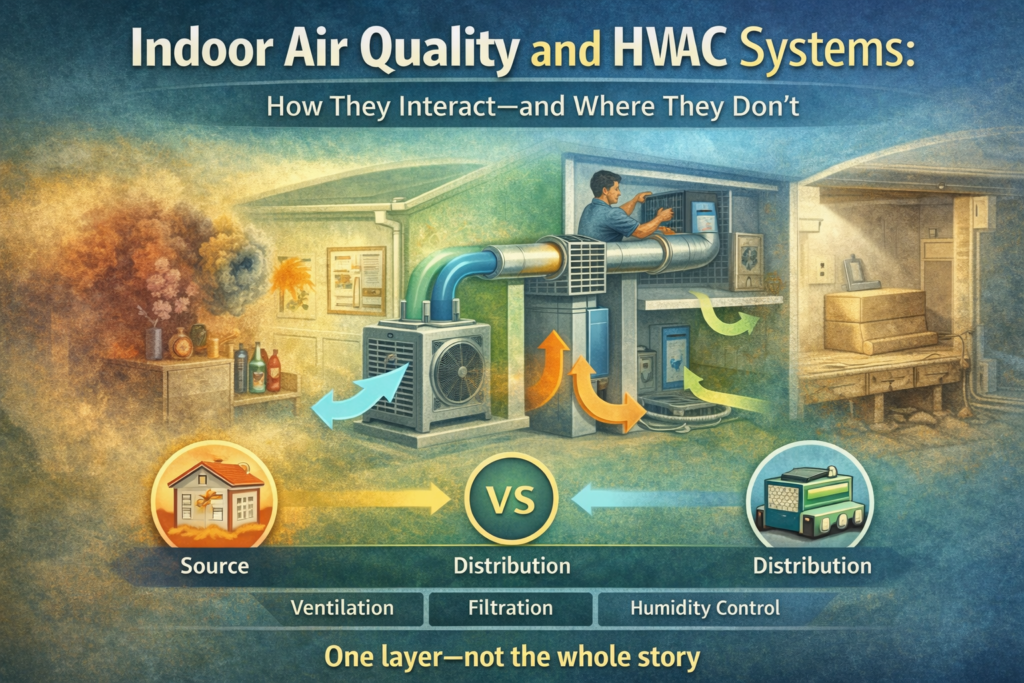
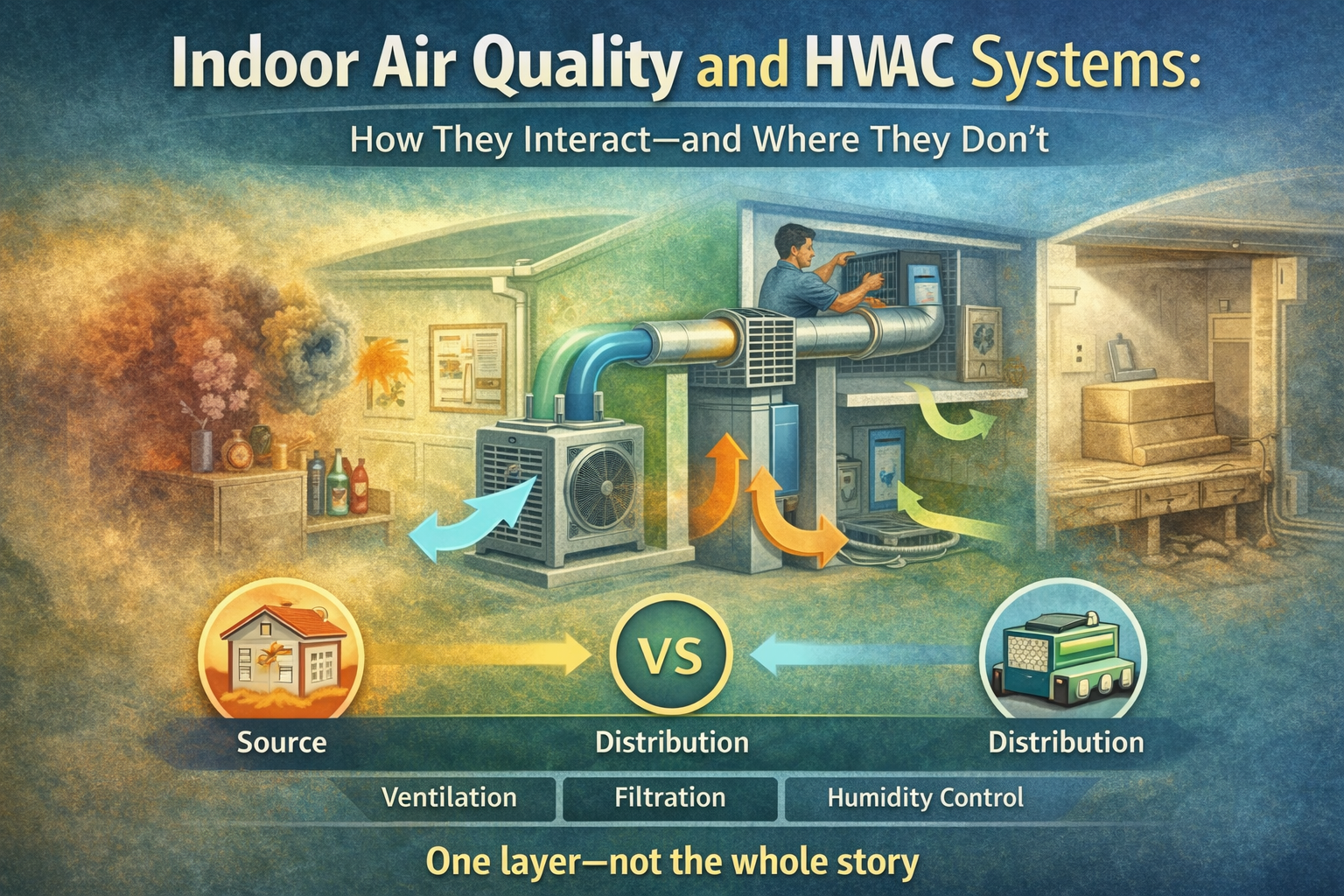
HVAC Is a Distribution System, Not a Source System
- One of the most important IAQ distinctions:
- Source issues vs. distribution issues
- HVAC systems are primarily distribution systems
- They move air that already exists in the building
- In most cases:
- They do not generate contaminants themselves
Common HVAC-Related IAQ Patterns
- The system is moving contaminated air from another location
- The system is not diluting contaminants effectively
- The system is making an existing issue more noticeable through circulation
- Identifying which pattern applies prevents unnecessary mechanical changes
HVAC vs Indoor Air Quality: Responsibility Comparison
HVAC System Role
- Moves and conditions air
- Influences distribution
- Affects comfort and airflow
- Rarely creates pollutants
Indoor Air Quality Role
- Defined by sources and conditions
- Influences exposure
- Affects health perception
- Often shaped by non-mechanical sources
- This explains why HVAC upgrades alone don’t automatically improve IAQ
When HVAC Is Likely Part of the IAQ Problem
- HVAC deserves focused attention in certain situations
- Commercial Indoor Air Quality Testing
Inadequate or Inconsistent Ventilation
- Outdoor air is introduced:
- Inconsistently
- Insufficiently
- Pollutants build up even when sources are minor
- Often occurs after:
- Occupancy changes
- Space-use changes without system adjustment
Uneven Air Distribution
- Some rooms feel stale
- Others feel fine
- Allows contaminants to linger in specific areas
Filtration Mismatch or Maintenance Gaps
- Poorly selected or installed filters
- Infrequent maintenance
- Over-filtering that restricts airflow
- All can contribute to circulation issues
Humidity Imbalance
- Over-drying or poor moisture control
- Influences comfort and biological activity
- Often described as an “air quality problem” even without contaminants
When HVAC Is Not the Root Cause
- Many IAQ issues originate elsewhere
- Common non-HVAC sources include:
- Building materials or finishes
- Occupant activities
- Moisture intrusion
- Outdoor air sources
- In these cases:
- HVAC may only make the issue more noticeable
- Replacing equipment without addressing sources:
- Rarely solves the problem
- Often leads to repeat complaints
Real-World Micro-Scenarios
Residential Example
- Musty air noticeable only when HVAC runs
- Air quality Assessment finds moisture in crawl space
- HVAC airflow is distributing—not creating—the issue
Commercial Example
- Office reports uneven comfort after layout change
- HVAC distribution no longer matches occupancy
- Air quality testing sources remain unchanged
- These examples show why HVAC must be evaluated in context
HVAC and IAQ Assessment: How They Intersect
- In a proper IAQ assessment:
- HVAC is evaluated as part of the environment
- Not as a default culprit
- Assessment questions typically include:
- How does air move through the space?
- Where does outdoor air enter?
- How does the system operate under normal conditions?
- Do complaint patterns align with airflow behavior?
- Goal:
- Understanding
- Not automatic equipment changes
- Many assessments conclude:
- HVAC performance is appropriate
- Attention should shift elsewhere
- That stopping point is valid
Decision Summary
- HVAC affects how air moves
- Indoor air quality depends on what’s in that air
- Confusing the two leads to:
- Unnecessary mechanical changes
- Missed root causes
Residential vs Commercial HVAC–IAQ Dynamics
Residential Settings
Residential Indoor Air Quality Testing
- Simpler systems
- Variable occupancy
- Comfort perception plays a large role
- Small airflow or humidity changes can feel significant
Commercial Settings
- More complex systems
- Defined ventilation requirements
- Documentation often matters more than perception
- Focus on consistency and policy
- Applying assumptions from one context to the other creates confusion
Common Misunderstandings About HVAC and Indoor Air Quality
- “Bad air quality means the HVAC system is failing.”
- Often false
- HVAC frequently exposes issues it didn’t create
- “Better filters always fix air quality.”
- Filtration is one tool, not a universal solution
- “HVAC upgrades solve IAQ problems.”
- Only when HVAC is part of the cause
- “Mechanical fixes come first.”
- Usually come last, after understanding sources and patterns
HVAC Changes vs IAQ Outcomes
- HVAC changes are:
- Tangible
- Visible
- IAQ outcomes depend on:
- Sources
- Building use
- Airflow patterns
- System interaction
- Mechanical changes without context can:
- Improve comfort
- Do nothing
- Make conditions worse
Using HVAC as One Layer in an IAQ Strategy
- Effective IAQ decisions treat HVAC as one layer
- The broader picture includes:
- How the building is used
- What sources exist
- How air moves
- Which conditions actually matter
- HVAC systems are powerful tools:
- Only when applied with context
The Right Mental Model
- Think of HVAC as:
- The circulatory system of a building
- It does not decide:
- What enters the bloodstream
- It determines:
- How things move once they’re there
- Good IAQ decisions:
- Start with sources and conditions
- Then evaluate how HVAC interacts
- Not by assuming the system is the problem
Final Perspective
- HVAC and IAQ are connected but distinct
- Understanding their roles prevents:
- Overcorrection
- Unnecessary upgrades
- The best outcomes come from:
- Context
- Restraint
- Clear boundaries