
Commercial Indoor Air Quality Testing: What It Tells You, What It Can’t, and When It’s Worth Doing
Introduction: Why Commercial IAQ Concerns Start With Uncertainty
- Commercial IAQ concerns rarely begin with clear evidence
- Common triggers include:
- Employee or tenant complaints
- Intermittent odors
- Productivity or comfort issues
- Insurance, compliance, or lease documentation questions
- Decision-makers usually want to answer one question:
- Is there actually a problem—or just uncertainty?
- Commercial IAQ testing exists to:
- Reduce uncertainty
- Support informed decisions
- When used poorly:
- It creates numbers without context
- Leads to decisions without confidence
A Note on Compliance, Documentation, and Risk Context
- Commercial IAQ testing is often associated with:
- OSHA guidance
- ASHRAE frameworks
- Industry best practices
- In practice:
- Testing is rarely about hitting a single numeric threshold
- It’s about demonstrating:
- Due diligence
- Reasonable evaluation
- Documented response
- For many organizations, value lies in:
- Showing conditions were assessed properly
- Interpreted responsibly
- Addressed proportionally
- The goal:
- Risk management and clarity
- Not enforcement or box-checking
What Commercial Indoor Air Quality Testing Really Means
- Commercial IAQ testing is a measurement and documentation process
- Used in non-residential environments to evaluate conditions that may affect:
- Occupants
- Operations
- Liability exposure
- Unlike residential testing, it is rarely about reassurance alone
- Common drivers include:
- Employee or tenant health complaints
- Risk or liability management
- Insurance or lease requirements
- Due-diligence reviews
- The purpose is not to pass or fail a building
- The purpose is to reach reasonable confidence
- Testing:
- Does not diagnose health issues
- Does not assign fault
- Does not define remediation on its own
- Results must be interpreted alongside:
- Building design
- HVAC performance
- Actual space use

Where Commercial Indoor Air Quality Testing Is Commonly Used
- Commercial IAQ testing is used across many environments
- Common settings include:
- Office buildings (single- and multi-tenant)
- Retail and hospitality spaces
- Warehouses and distribution centers
- Schools and training facilities
- Healthcare and assisted-living environments
- Managed commercial real estate portfolios
- Each setting differs in:
- Occupancy density
- Exposure duration
- Tolerance for uncertainty
- Effective testing adapts to how a space functions
- Scope clarification:
- “Local” means within the operational footprint
- Not consumer proximity-based services
What Commercial Indoor Air Quality Testing Can Measure
- Commercial IAQ testing includes multiple categories
- Each answers a different question
- None are meaningful without context
Particulate Matter
- PM2.5 / PM10
- Related to:
- Filtration effectiveness
- Activity levels
- Process dust
Chemical Compounds
- Volatile organic compounds (VOCs)
- Indicators of:
- Material off-gassing
- Cleaning products
- Industry-specific solvents
Combustion Byproducts
- Carbon monoxide (CO)
- Nitrogen dioxide (NO₂)
- Indicators of:
- Exhaust infiltration
- Backdrafting
- Combustion appliance issues
Biological Indicators
- Airborne mold spore concentrations
- Limited microbial indicators when justified
Ventilation & Comfort Metrics
- Carbon dioxide (CO₂) as a ventilation proxy
- Temperature and relative humidity
- Airflow balance when paired with inspection findings
- Not every building needs every test
- Measuring everything without a defined objective creates noise
Inspection vs Testing: A Critical Decision Boundary
- A common mistake:
- Jumping straight to testing
- Inspection should come first when:
- Visible moisture or water damage exists
- HVAC maintenance is inconsistent
- Odors are localized or time-specific
- Complaints align with operational schedules
- Testing makes sense when:
- Symptoms exist without visible causes
- Multiple occupants report similar concerns
- Documentation is required
- Baselines need to be established
- Both are appropriate when:
- Issues persist after operational fixes
- Liability or compliance exposure exists
- Testing without inspection documents symptoms
- Inspection without testing can miss invisible contributors
- The two work best together
- Indoor air quality services
How Commercial Indoor Air Quality Testing Is Conducted
- A professional indoor air quality testing services process follows a structured sequence:
Pre-Assessment Review
- Understand complaints
- Review building history and use
- Identify occupancy patterns
On-Site Evaluation
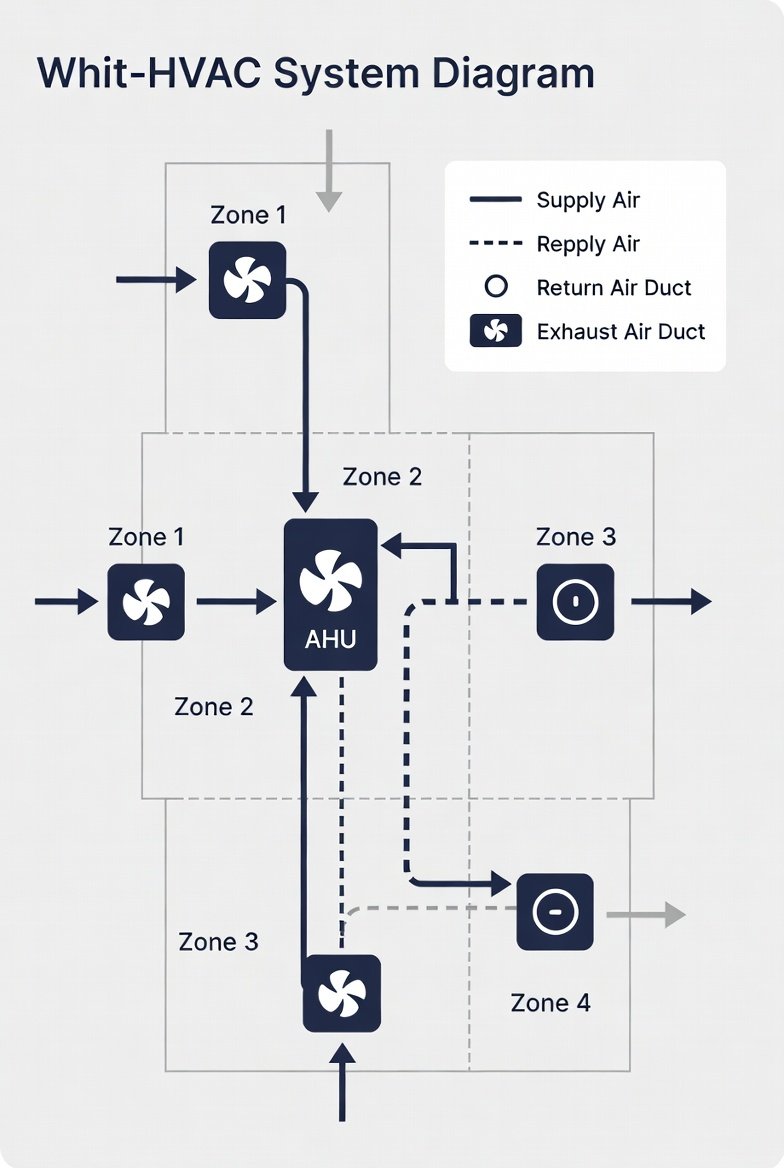
- Identify HVAC zones
- Evaluate air pathways
- Select sampling locations
Targeted Sampling
- Use real-time monitors or air samples
- Scope based on objectives
Laboratory Analysis (When Needed)
- Common for:
- Mold
- Specific chemical compounds
Contextual Interpretation
- Compare results to:
- Guidance ranges
- Operational expectations
Clear Reporting
- Explain:
- What matters
- What doesn’t
- What actions are reasonable
- Interpretation is more valuable than raw data
What Commercial IAQ Testing Can—and Cannot—Tell You
What It Can Do:
- Identify elevated or unusual conditions
- Document air quality at a specific time
- Support HR, legal, or compliance decisions
- Narrow down likely contributors
What It Cannot Do:
- Diagnose medical conditions
- Predict future performance alone
- Automatically define remediation scope
- Replace mechanical or system evaluations
- Testing informs judgment—it doesn’t replace it
When Commercial Air Quality Testing Is Often Unnecessary
- Testing may not be appropriate when:
- Complaints are clearly comfort-related
- HVAC maintenance issues are obvious
- Construction or renovation is ongoing
- Occupancy is minimal
- In these cases:
- Operational fixes should come first
Interpreting Results Without Creating Panic
- Commercial IAQ data must be read carefully
- Key principles:
- A single elevated reading ≠ hazard
- Background levels vary by region and use
- Exposure duration matters
- Trends matter more than snapshots
- Responsible reporting explains relevance
- Often, results support a decision to stop
A Clear Stopping Point
- If testing shows:
- Typical conditions
- Stable ventilation indicators
- No unusual exposures
- Stopping is often the correct outcome
- Additional testing or remediation should only proceed when justified
- The goal:
- Reasonable confidence
- Not perfect air
Bottom Line
- Commercial IAQ testing works best as:
- A decision-support tool
- A documentation resource
- When used with:
- Inspection
- Context
- Clear boundaries
- It helps organizations:
- Reduce uncertainty
- Manage risk
- Demonstrate due diligence
- When used without limits:
- It creates confusion and unnecessary expense