
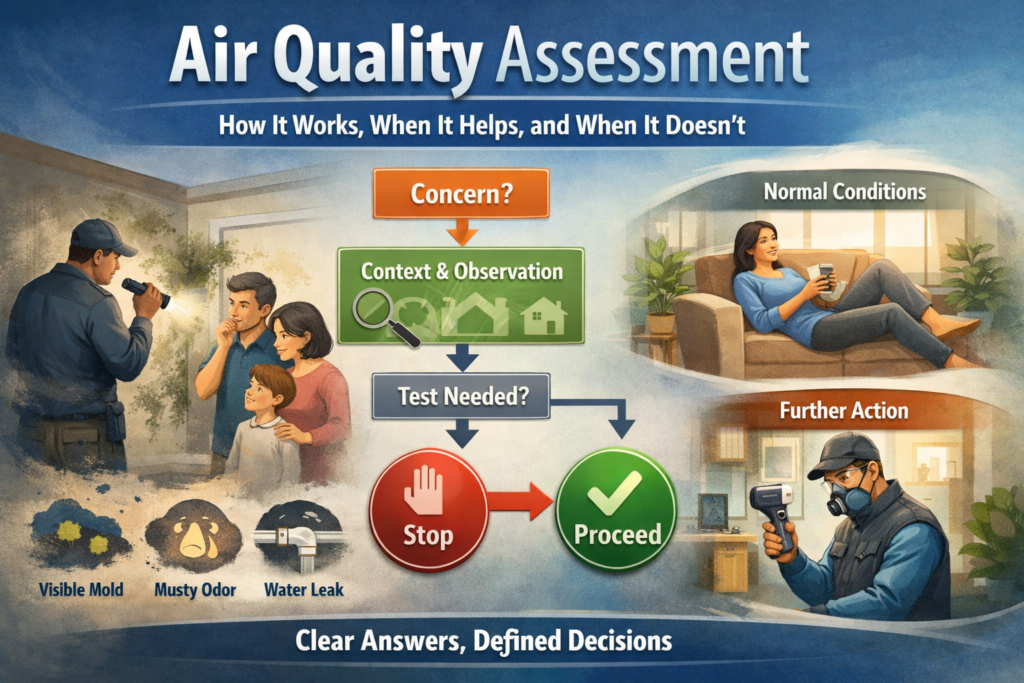
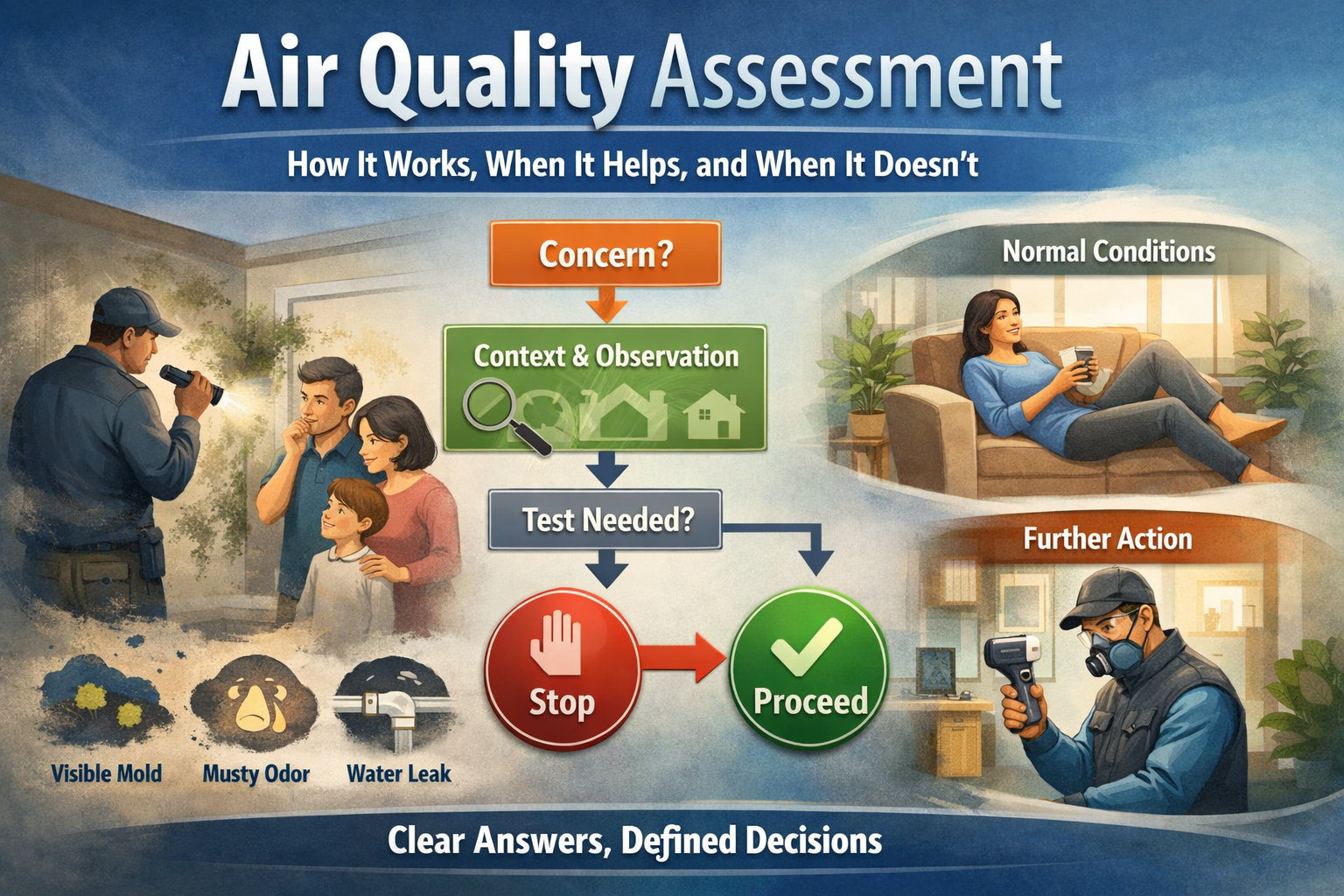
Air Quality Assessment: How It Works, When It Helps, and When It Doesn’t
Introduction: Why Air Quality Assessments Exist
- An air quality assessment sits between reassurance and action
- It is not:
- A repair
- A treatment plan
- Proof that something is wrong
- Its role is precise and bounded
- Core question it answers:
- Is indoor air quality likely contributing to what’s happening—and do we need more information to decide?
- People reach this step with:
- Uncertainty rather than evidence
- Transaction-driven concern
- Conflicting advice without clear next steps
- A proper assessment:
- Does not escalate fear
- Converts uncertainty into clarity
- Defines clear decision boundaries
Industry Reality: Why Many Assessments Stop Early
- Observed industry pattern:
- Many residential and light-commercial assessments end without recommending testing
- Reason:
- Observation and context already explain conditions
- This stopping point is:
- Not a failure
- Often the goal
- A successful assessment often concludes:
- No further action is needed
What an Air Quality Assessment Actually Is
- An air quality assessment is a structured evaluation
- Purpose:
- Determine whether air quality is a meaningful factor
- Decide whether further steps are justified
- It is not defined by a single test or device
- It combines three deliberate elements:
Context
- How the building is used
- Who occupies it
- What has changed recently
- How concerns appear over time
- Patterns matter more than isolated complaints
Observation
- Review of visible and environmental influences:
- Moisture behavior
- Ventilation pathways
- Pressure differences
- Material interactions
Measurement Logic
- Deciding whether measurement will reduce uncertainty
- If so:
- What to measure
- When to measure
- Measurement is selective, not automatic
Terminology You May See
- Air Quality Assessment
- Indoor Air Quality (IAQ) Assessment
- Building Air Quality Assessment
- Workplace Air Quality Assessment
- Terminology varies
- Intent remains the same:
- Decision clarity before action
The Defining Feature of an Assessment
- Restraint
- Value comes from:
- Collecting only information that changes a decision
- Not from:
- Generating volume
- Producing numbers for their own sake
Assessment vs Testing vs Control Checks
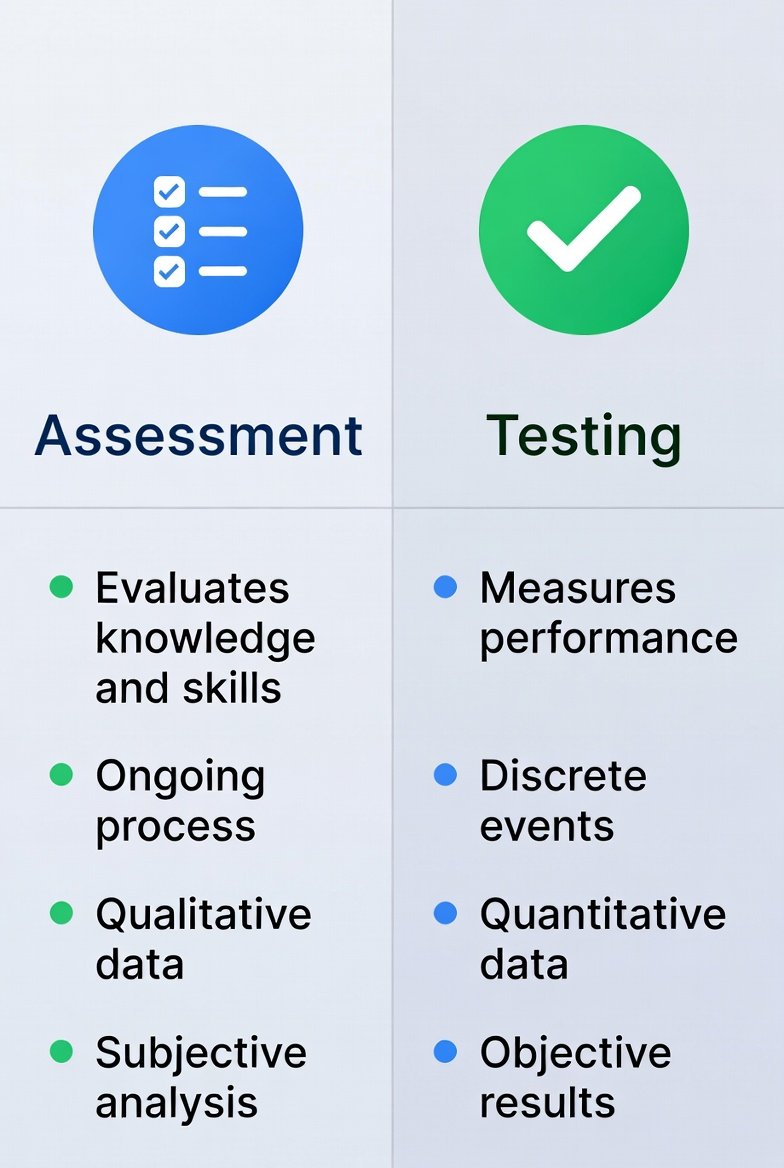
Air Quality Assessment vs Air Quality Testing
Air Quality Assessment
- Decides whether testing is needed
- Starts with context and observation
- Often identifies a clear stopping point
- May involve no testing at all
Air Quality Testing
- Measures what is present
- Produces numbers and samples
- Always generates data
- Requires interpretation afterward
- An assessment may include testing
- Testing is not the default
Air Quality Control Tests
- Narrow, confirmation-focused measurements
- Commonly used to:
- Establish a baseline
- Confirm system performance
- Verify stability over time
- Purpose:
- Validate conditions
- Not diagnose causes
- When included in an assessment:
- They support conclusions
- They do not drive them
Key Takeaway (If You Only Read One Thing)
- An air quality assessment exists to:
- Decide whether more information is needed
- It does not exist to:
- Confirm a problem
- Justify action
- In many cases:
- Its most useful outcome is knowing where to stop
When an Air Quality Assessment Is Helpful
- Most useful when uncertainty is the issue
- Adds value when causes are not obvious
Common Helpful Scenarios
- Unexplained discomfort or symptoms
- Post-change indoor environments
- Transaction or documentation needs
- Conflicting advice or results
Real-World Micro-Scenarios
Residential
- Kitchen renovation followed by lingering odors
- No visible damage
- Assessment determines whether conditions are stabilizing naturally
- Testing may or may not be needed
Commercial
- Small office with uneven comfort after HVAC changes
- Commercial Indoor Air Quality Testing
- Assessment reviews airflow and usage
- Testing only recommended if uncertainty remains
Assessment Ends With No Action
- Findings align with normal variation
- Conditions consistent with occupancy and ventilation
- No testing recommended
- Process stops appropriately
When an Air Quality Assessment Is Usually Not Necessary
- Assessment is often not appropriate when:
- Visible water damage or active leaks exist
- Persistent combustion odors are present
- Obvious mold growth is visible
- Known mechanical failures already exist
- In these cases:
- The decision threshold is already crossed
- Direct indoor air quality inspection or corrective work is more appropriate
How an Air Quality Assessment Is Typically Conducted
- Common logic path:
- Concern identified
- Indoor air quality testing services
- Context review
- Observation
- Decision on testing
- Typically performed by:
- Independent IAQ professionals
- Environmental consultants
- Building science specialists
- Not usually led by:
- Remediation-first contractors
- Possible outcomes:
- Targeted testing
- Monitoring
- Clear conclusion that no action is needed
Decision Triggers at a Glance
- Unexplained symptoms
- Assessment: Yes
- Next step: Assessment first
- Visible moisture
- Assessment: No
- Next step: Direct inspection
- Post-renovation odors
- Assessment: Yes
- Next step: Assessment → targeted test
- Transaction due diligence
- Assessment: Yes
- Next step: Documentation assessment
Interpreting Results Without Overreacting
- Indoor air is not sterile
- Natural variation is normal
- Presence does not equal problem
- A proper assessment explains:
- What is typical
- Which patterns matter
- Which findings are inconclusive by design
- Monitoring instead of action is often correct
Residential vs Commercial Assessment Logic
Residential Assessments Emphasize
- Comfort
- Livability
- Occupant perception
- Reassurance through explanation
Commercial Assessments Emphasize
- Documentation
- Consistency
- Risk management
- Compliance-adjacent needs
- Mixing these expectations leads to confusion
Common Misunderstandings About Air Quality Assessments
- “An assessment will tell me exactly what to fix”
- Sometimes
- Often nothing needs fixing
- “More testing means a better assessment”
- More testing often creates noise
- “Numbers demand action”
- Numbers require interpretation
- “An assessment is just a sales step”
- A valid assessment includes clear stopping points
Using an Air Quality Assessment as a Decision Filter
- Best way to think about an assessment:
- A filter
- It filters:
- Anxiety into defined questions
- Vague concerns into bounded possibilities
- Unnecessary action out of the process
- Reaching a stopping point:
- Is not failure
- Is often the intended outcome
Final Perspective
- Air quality assessments are about:
- Understanding before acting
- Their value lies in:
- Knowing when to proceed
- Knowing when to stop
- The calmest conclusion is often the correct one