
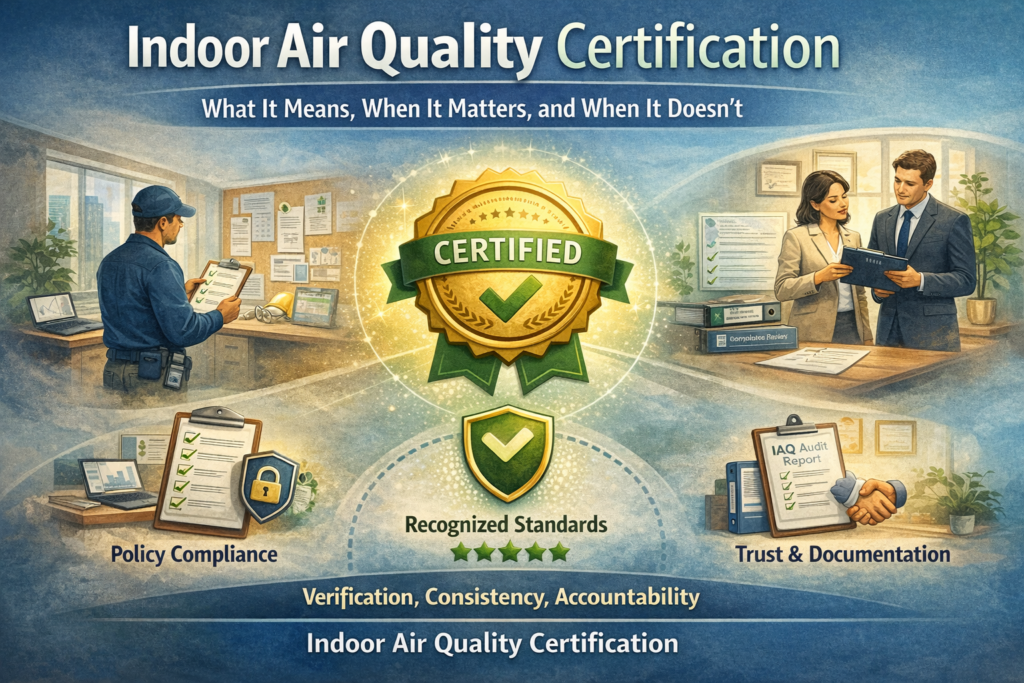
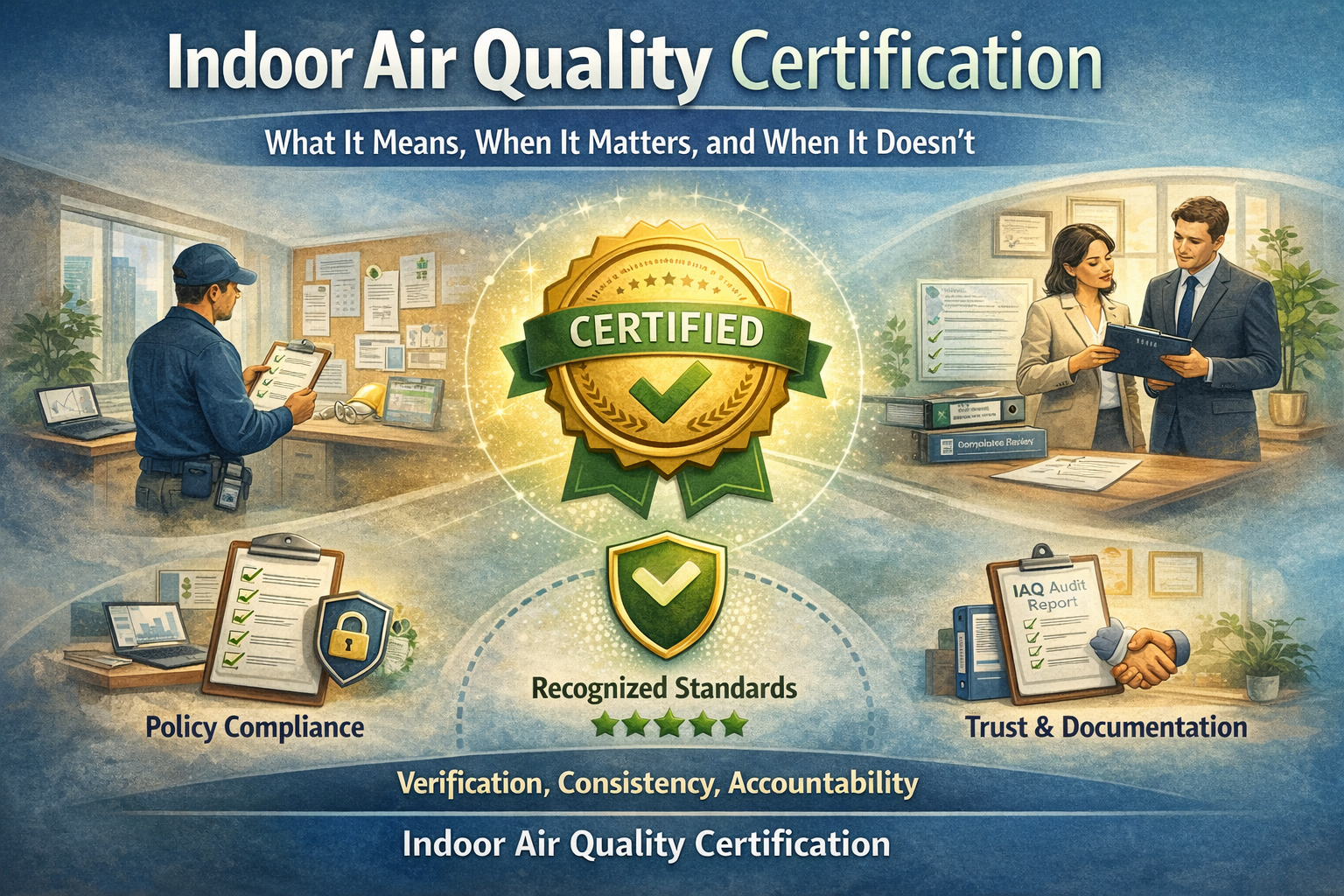
Indoor Air Quality Certification: What It Means, When It Matters, and When It Doesn’t
Introduction: Why “Certification” Sounds More Definitive Than It Is
- The word certified implies:
- Proof
- Resolution
- Finality
- In practice, IAQ certification plays a narrow, disciplined role
- Certification exists to:
- Document alignment with a defined standard or framework
- Indoor Air Quality Services
- It does not:
- Diagnose problems
- Predict future conditions
- Replace investigation
- Certification is most valuable where:
- Consistency
- Verification
- Third-party trust
- Matter more than discovery
What Indoor Air Quality Certification Actually Is
- IAQ certification is a formal confirmation
- It verifies that a building, space, process, or professional:
- Aligns with a defined IAQ standard or framework
- At a specific point in time
- Depending on the program, certification may evaluate:
- Ventilation performance
- Environmental control practices
- Material or finish emission policies
- Operational procedures
- Professional competency
- What matters most:
- What is being certified
- Under what assumptions
Common Terminology You May See
- Indoor Air Quality Certification
- Building Air Quality Certification
- Workplace Air Quality Certification
- Terminology varies
- Function remains the same:
- Verification, not discovery
Core Categories of Indoor Air Quality Certification
Building-Level Certification
- Applies to:
- A building
- A space
- A facility
- Typically reviews:
- Ventilation adequacy
- Maintenance and operational practices
- Environmental management policies
- Documentation tied to defined standards
- Commonly used for:
- Commercial indoor Air quality
- Workplace compliance programs
- Commercial property management
- Institutional settings
- Real estate transactions
- Air quality assessment
- Important limits:
- Does not continuously monitor conditions
- Does not guarantee future performance
Professional or Credential-Based Certification
- Applies to:
- Individuals, not buildings
- Confirms that a professional has:
- Completed defined training
- Demonstrated IAQ knowledge
- Met baseline competency requirements
- What it means:
- The professional is qualified to evaluate IAQ responsibly
- What it does not mean:
- That indoor air quality itself is certified
Process or Program Certification
- Focuses on:
- How IAQ-related work is performed
- Certifies that:
- Recognized protocols were followed
- Documentation met defined criteria
- Reporting aligned with established frameworks
- Primary value:
- Consistency
- Defensibility
- Especially relevant in:
- Compliance-adjacent environments
What Indoor Air Quality Certification Proves—and What It Does Not
What Certification Can Legitimately Demonstrate
- A recognized IAQ standard or framework was followed
- Defined criteria were met at the time of evaluation
- Documentation exists for third-party review
- A process was applied consistently and defensibly
- These outcomes matter most when:
- Proof
- Accountability
- Reassurance
- Are required
What Certification Cannot Guarantee
- Ongoing indoor air quality conditions
- Absence of future issues
- Health outcomes for occupants
- “Ideal” or risk-free environments
- Indoor environments are dynamic
- Certification captures:
- A moment
- Not a permanent state
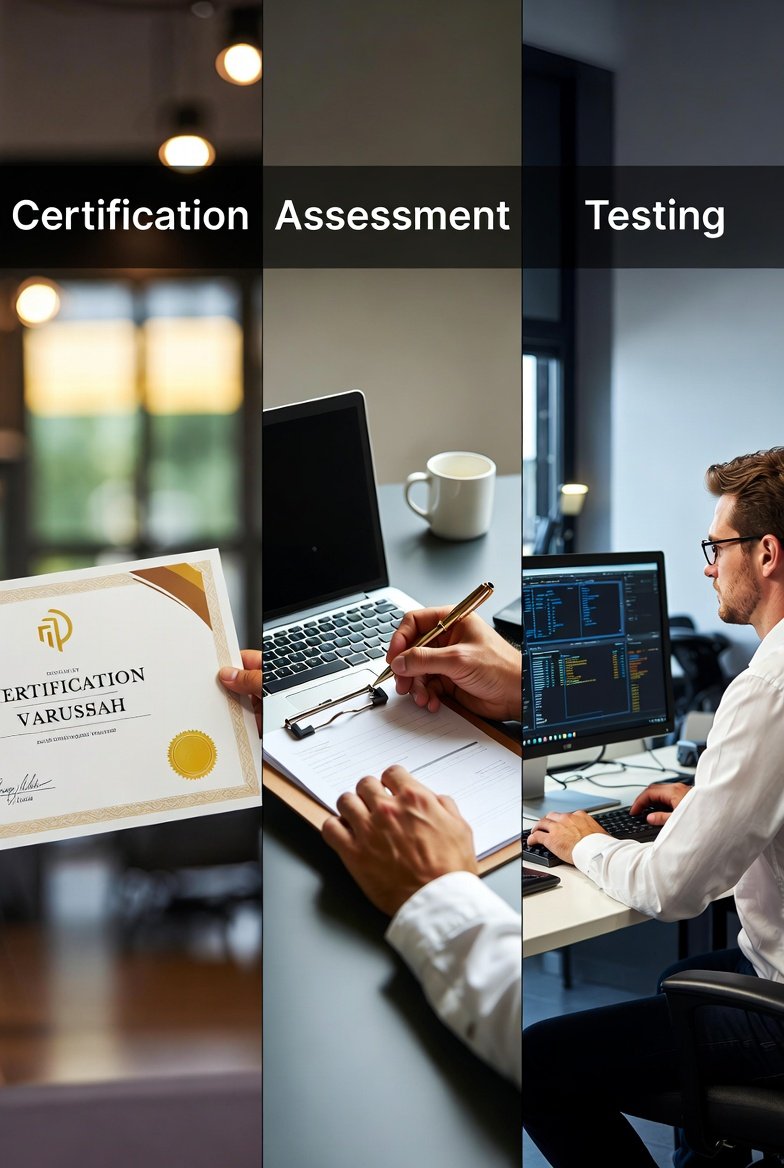
Certification vs Assessment vs Testing
Air Quality Assessment
- Used to:
- Evaluate context
- Reduce uncertainty
- Decide what information is needed
Air Quality Testing
- Used to:
- Measure specific parameters
- Generate data under defined conditions
Indoor Air Quality Certification
- Used to:
- Document alignment with a standard or framework
- At a specific point in time
Decision checkpoint
- Assessment clarifies unknowns
- Testing generates data
- Certification documents alignment
- These are complementary, not interchangeable
- Certification typically follows assessment logic
- Used as discovery, certification is often misapplied
When Indoor Air Quality Certification Makes Sense
- Certification works best when:
- Documentation matters more than investigation
Appropriate Use Cases
- Workplace policy compliance
- Demonstrates alignment with recognized IAQ frameworks
- Property transactions and due diligence
- Provides neutral documentation at time of review
- Ongoing IAQ management programs
- Confirms consistency of established practices
- Stakeholder reassurance
- Shows that recognized standards were applied
- In these cases:
- Certification functions as evidence
- Not analysis
When Certification Is the Wrong Tool
- Certification is often misused when:
- Uncertainty or symptoms are the real issue
- Usually not the right first step when:
- Occupants report unexplained discomfort
- Indoor conditions recently changed
- Visible moisture or system issues exist
- Causes are unknown or disputed
- In these situations:
- Certification may produce documentation
- Without providing clarity
- Assessment logic should come first
How Indoor Air Quality Certification Is Typically Achieved
- While programs vary, most include:
Defined Scope
- Clear boundaries on:
- Spaces
- Systems
- Practices included
Standardized Criteria
- Benchmarks or qualitative requirements
- Defined by the certifying body
Verification and Documentation
- Evidence that criteria were met
- May include:
- Records
- Reviews
- Limited measurements
Time-Bound Validity
- Certification reflects:
- Conditions at a specific point
- Not indefinitely
- Typically facilitated by:
- Independent IAQ professionals
- Environmental consultants
- Building science specialists
- Not usually driven by:
- Remediation-first contractors
Certification as a Trust Signal (E-E-A-T Context)
- Certification functions as:
- A credibility layer
- Not a solution
- Helps answer:
- Was a recognized framework used?
- Was the process consistent and defensible?
- Is documentation available for review?
- Does not replace:
- Professional judgment
- Contextual evaluation
Residential vs Commercial Certification Use
Residential Settings
- Often used for:
- Reassurance
- Transactions
- Should be interpreted cautiously
- Awareness of limits is critical
Commercial & Workplace Settings
- More commonly tied to:
- Policies
- Documentation
- Risk management
- Value lies in:
- Standardization
- Consistency
- Keeping contexts distinct prevents misinterpretation
Common Misunderstandings About IAQ Certification
- “Certified means the air is safe.”
- It means criteria were met at a moment in time
- “Certification replaces assessment.”
- Certification documents compliance
- Assessment explores uncertainty
- “Once certified, nothing else is needed.”
- Indoor environments change
- “Certification guarantees health outcomes.”
- It does not
Using Indoor Air Quality Certification Correctly
- Certification works best as:
- Confirmation
- Not discovery
- Most effective when:
- Goals are clearly defined
- Standards fit the context
- Limits are understood
- Certification should:
- Support decisions
- Not make them automatically
Final Perspective
- Indoor air quality certification is about:
- Verification
- Consistency
- Trust
- Its value lies in:
- Documenting alignment
- Not in:
- Diagnosing problems
- Predicting the future
- Used correctly:
- It strengthens decisions
- Used without context:
- It creates false certainty