
Commercial Indoor Air Quality Testing Cost: What You’re Paying For—and When It’s Justified
Introduction: What Businesses Really Mean by “Testing Cost”
- Businesses searching commercial IAQ testing cost are rarely price shopping
- The real question is strategic:
- Will this expense reduce risk—or just generate data that changes nothing?
- In commercial settings, IAQ testing is:
- Not routine maintenance
- A situational decision
- Common triggers include:
- Employee or tenant complaints
- Insurance or documentation questions
- Disputes or due-diligence reviews
- Cost reflects more than sampling:
- Scope
- Defensibility
- Interpretation
- This page explains:
- Typical commercial cost ranges
- What drives pricing
- When testing is justified
- When it’s avoidable
Commercial Cost Context: Documentation, Risk, and Decision Support
- Commercial IAQ testing is often associated with professional guidance frameworks
- In practice:
- It’s rarely about meeting a single numeric limit
- From a business perspective, testing adds value by:
- Demonstrating reasonable evaluation of complaints
- Creating documented evidence for records or disputes
- Supporting proportionate, defensible decisions
- Testing should be viewed as:
- A risk-management tool
- A decision-support expense
- It is not:
- A corrective action
- A guarantee of outcomes
Why Commercial IAQ Testing Costs Vary So Much
- Commercial air testing is not standardized
- Costs vary because:
- Building size and layout differ widely
- HVAC systems range from simple to complex
- Complaints range from informal to legally sensitive
- Some situations require defensible documentation
- Others only require internal clarity
- The same building can justify very different scopes
- Cost depends more on why testing is needed than where it’s performed
Typical Commercial Indoor Air Quality Testing Cost Ranges
Commercial Cost Tiers at a Glance
- Limited / screening testing
- Typical cost: $400–$900
- Best used for: narrow concern, early evaluation
- Targeted multi-parameter testing
- Typical cost: $900–$2,000
- Best used for: multiple indicators, ongoing complaints
- Documentation-level testing
- Typical cost: $2,000–$5,000+
- Best used for: records, disputes, due diligence
- Costs trend higher in:
- Urban markets
- Large metro areas
- Regions with higher lab fees or licensing requirements
- Large facilities or campuses may exceed these ranges
- Commercial indoor air quality
Limited or Screening-Level Commercial Testing
- Typical cost: $400–$900
- Appropriate when:
- A specific concern needs early evaluation
- Complaints are limited in scope or duration
- Formal documentation is not required
- Purpose:
- Determine whether further evaluation is warranted
- Limitations:
- Rarely sufficient for higher-risk situations
- Often a preliminary step only
Targeted Multi-Parameter Commercial Testing
- Typical cost: $900–$2,000
- Common when:
- Multiple indicators are evaluated together
- Lab analysis is required
- Mold spores
- VOCs
- Combustion byproducts
- Interpretation is included in reporting
- Often the best balance for:
- Offices
- Schools
- Managed commercial properties
- Balances:
- Useful clarity
- Cost control
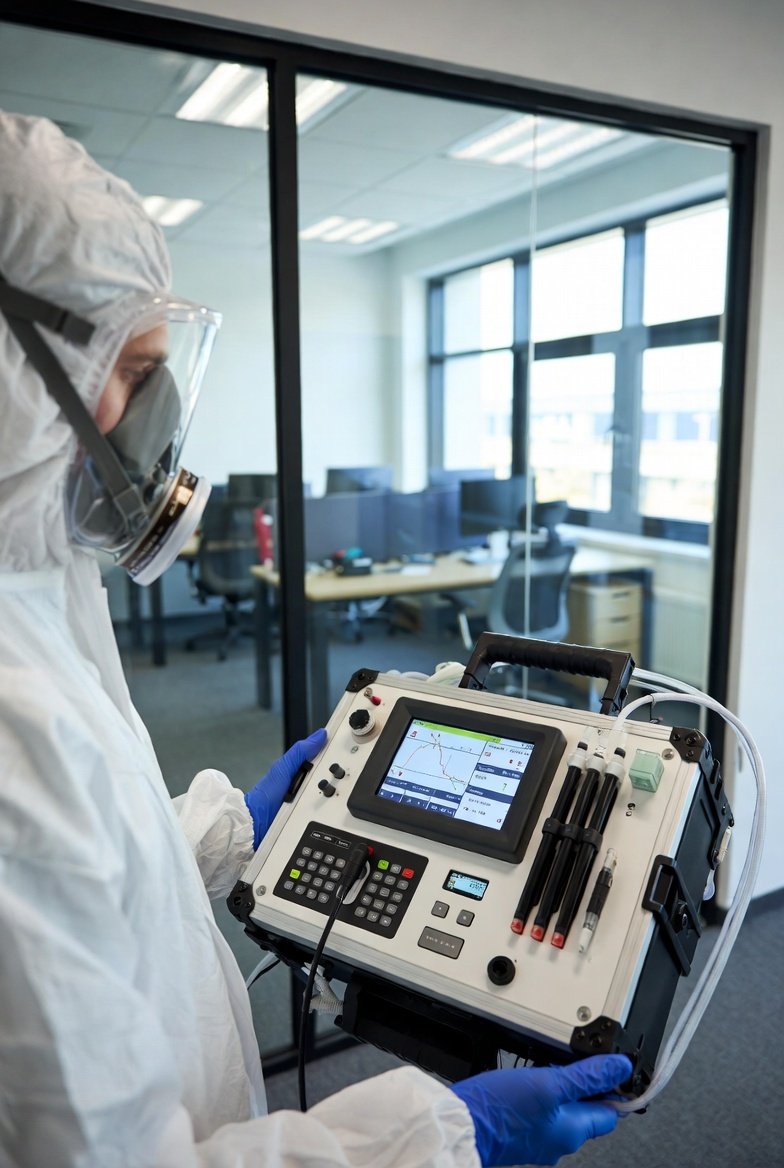
Documentation-Level or Comprehensive Commercial Testing
- Typical cost: $2,000–$5,000+
- Used when:
- Multiple zones or floors are involved
- Tenant spaces must be evaluated separately
- Results may be used in:
- Disputes
- Transactions
- Audits
- Cost reflects:
- Planning
- Sampling strategy
- Analysis
- Defensible reporting
- Data collection is only part of the expense
What Actually Drives Commercial IAQ Testing Costs
- Commercial testing is rarely priced by square footage alone
- Key cost drivers include:
Number of Zones and Samples
- Each additional zone increases:
- Labor
- Equipment time
- Lab fees
Type of Analysis
- Real-time monitoring costs less
- Laboratory analysis increases cost
Purpose of Testing
- Internal clarity costs less
- Formal documentation or dispute use costs more
Reporting and Interpretation
- Clear, defensible explanations increase value—and price
- Raw data alone is cheaper but less useful
Follow-Up or Repeat Testing
- Baseline plus confirmation testing increases cost
- May reduce uncertainty when justified
Inspection vs Testing: The Most Common Commercial Cost Mistake
- Unnecessary testing often happens when Air indoor inspection is skipped
Inspection Should Come First When:
- HVAC systems are poorly documented
- Performance is inconsistent
- Odors are zone-specific or time-specific
- Moisture or pressure imbalance is suspected
Testing Is Usually Justified When:
- Complaints persist without visible or mechanical causes
- Multiple occupants report similar issues
- Documentation is required for records or disputes
Real-World Commercial Scenarios
- Scenario 1
- Odor complaints in a multi-tenant office
- Inspection found negative pressure pulling air from a service corridor
- Indoor air quality services
- Airflow correction resolved complaints
- Thousands in testing costs avoided
- Scenario 2
- Post-renovation irritation in a commercial suite
- Inspection found no HVAC or moisture issues
- Targeted VOC testing confirmed off-gassing was declining
- No remediation required
- Inspection prevents unnecessary testing
- Targeted testing prevents unnecessary remediation
What Commercial IAQ Testing Can—and Cannot—Justify Spending On
- Commercial testing is a decision-support expense
Testing Justifies Its Cost When:
- Results change the next action
- Documentation reduces legal or operational risk
- A “no significant issue found” outcome supports closure
Testing Rarely Justifies Its Cost When:
- Causes are already known
- Results wouldn’t alter decisions
- Testing replaces maintenance or repairs
- Data that doesn’t change outcomes is not cost-effective
When Commercial IAQ Testing Is Often Not Worth the Budget
- Testing may not be appropriate when:
- Issues are clearly comfort- or schedule-related
- Active construction or renovation is underway
- Occupancy is minimal
- Known issues have already been corrected
- In these cases:
- Operational fixes
- Time
- Often resolve concerns more efficiently
A Practical Cost Decision Rule for Businesses
Before approving commercial IAQ testing, ask:
- What risk or question are we addressing?
- Would inspection answer this more efficiently?
- Will results change our next step?
- Do we need documentation—or just internal clarity?
If testing won’t change the decision or reduce risk, it’s usually not worth the cost.
Bottom Line on Commercial IAQ Testing Cost
- Commercial IAQ testing can range from under $1,000 to several thousand dollars
- The real value lies in:
- Risk reduction
- Decision clarity
- Not the data itself
- The most cost-effective testing:
- Answers the right question once
- Or confirms that no further action is required