
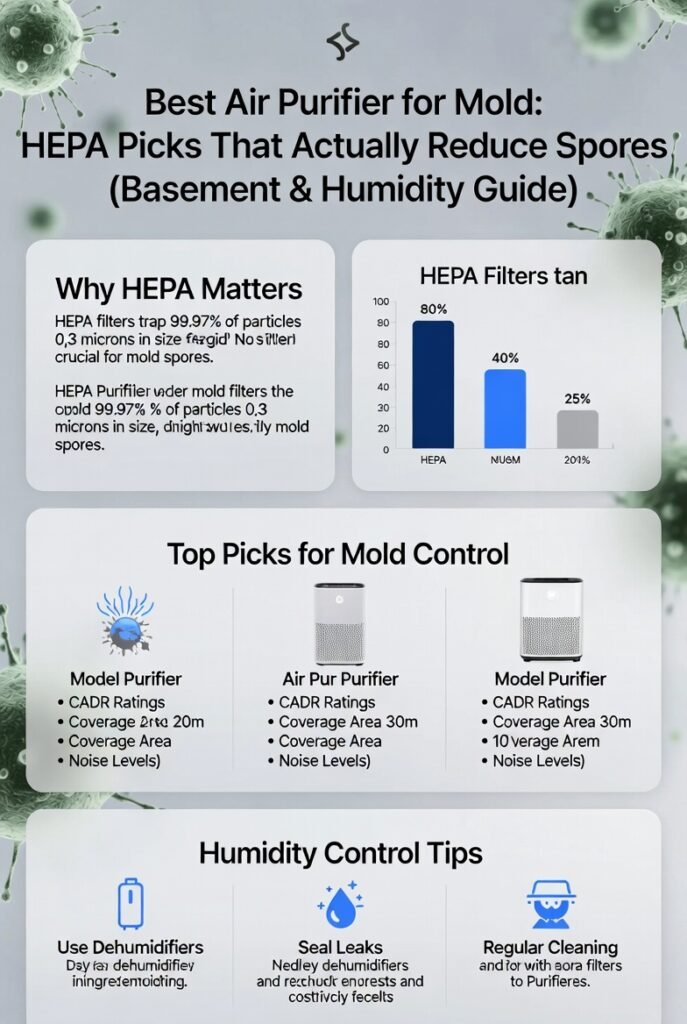
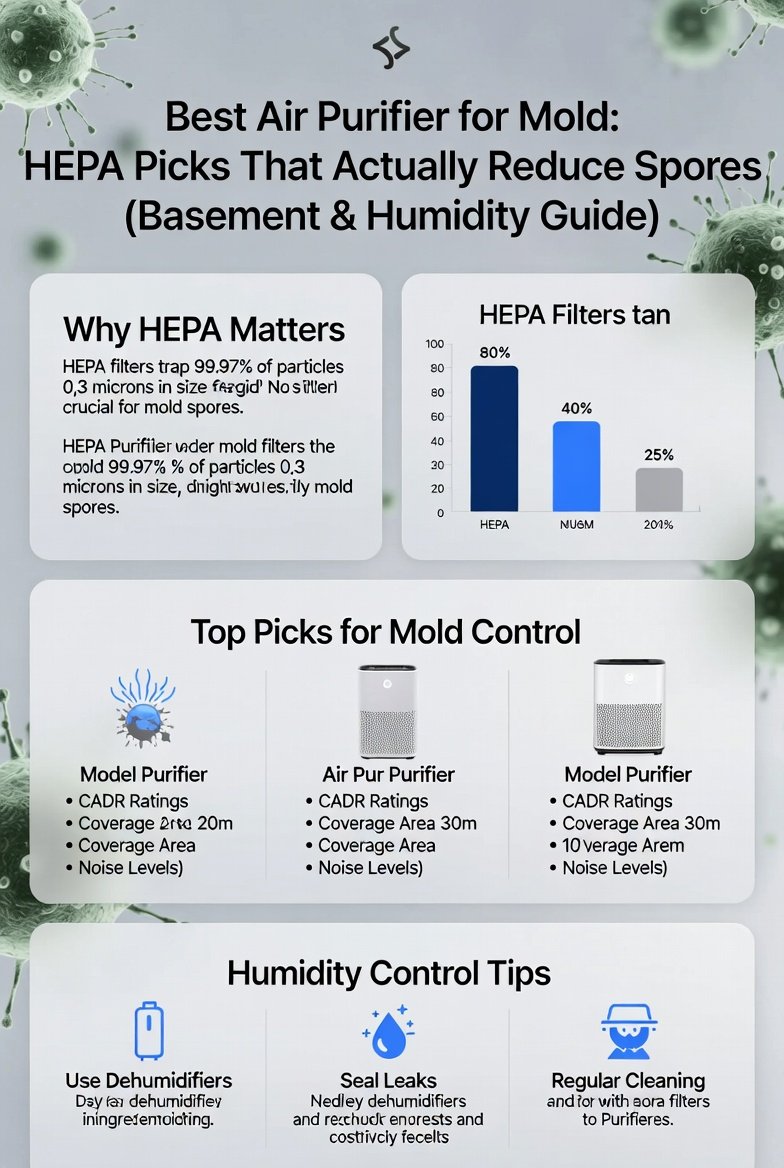
Best Air Purifier for Mold (What Works — and What Doesn’t)
If you’re researching the best air purifier for mold, you’re probably dealing with one of these:
- A musty basement smell
- Past water intrusion
- Allergy flare-ups in damp rooms
- Visible mold growth
- High indoor humidity
Here’s the clear, engineering-level reality:
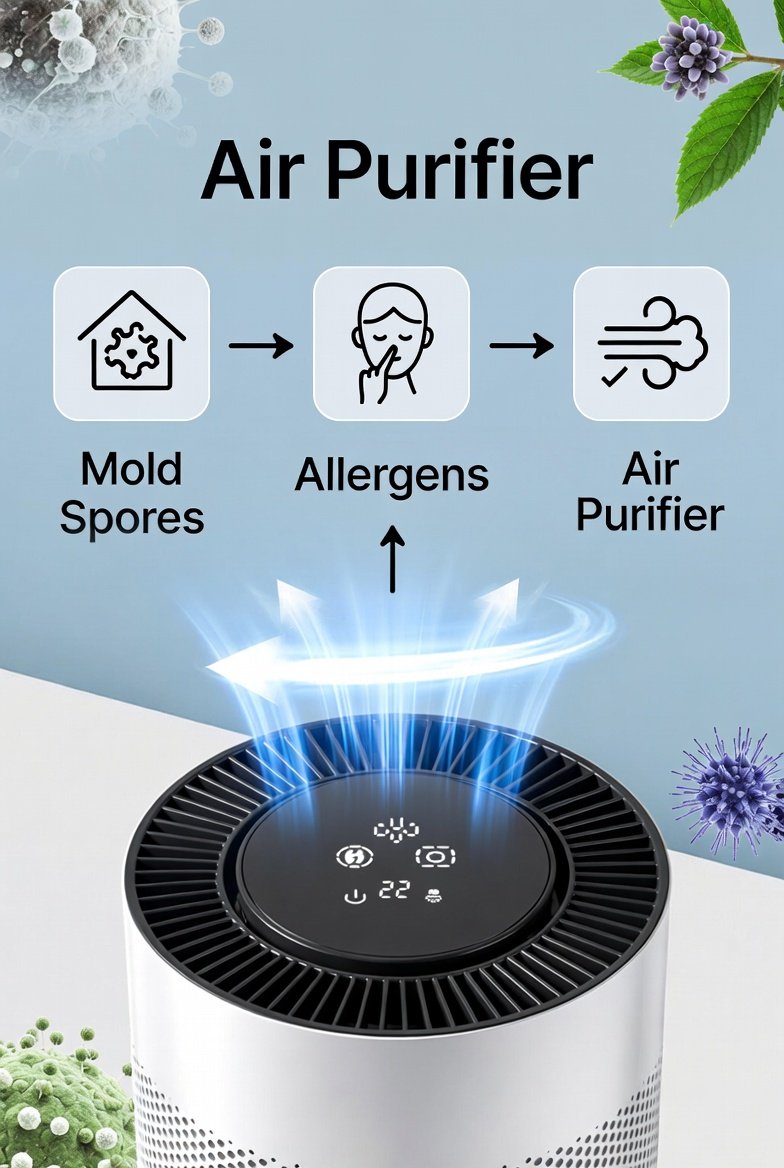
Air purifiers capture airborne mold spores.
They do not remove mold growing on surfaces.
If you see active mold colonies on drywall, wood, or insulation, moisture control and remediation come first. Air purification is a support layer — not a replacement for fixing the source.
For deeper indoor diagnostics, see:
Learn more:
indoor-air-quality-testing-guide
Quick Answer: Do Air Purifiers Help With Mold?
Yes — in a specific and measurable way.
Mold spreads by releasing microscopic spores into the air.
True HEPA filters are designed to capture fine airborne particles — including mold spores.
They help:
- Reduce airborne spore concentration
- Limit cross-room spread
- Lower allergen load
- Improve basement air quality
They do not:
- Kill mold colonies on surfaces
- Fix leaks or condensation
- Replace dehumidification
- Eliminate structural mold problems
This distinction matters.
Mold vs Mold Spores (Most People Confuse This)
Understanding the difference prevents unrealistic expectations.
Issue | What It Is | Primary Fix |
Visible mold growth | Active colony on material | Remediation + moisture control |
Airborne mold spores | Microscopic particles | HEPA filtration |
Musty odor | Microbial VOCs | Carbon filtration + humidity control |
High humidity | Moisture environment | Dehumidifier |
The Mold Lifecycle (Simple Model)
- Moisture rises above ~60% RH
- Mold colonies grow on damp surfaces
- Colonies release spores
- Spores circulate and settle
- New growth forms if moisture persists
A HEPA purifier interrupts Step 3 — airborne spread.
It does not stop Step 1.
For homes with pets and allergen layering, see:
Learn more:
⚠️ Critical Warning
If basement humidity remains above 50–55%,
a purifier alone will not prevent mold growth.
Moisture control is mandatory.
Building science guidance and public health agencies consistently emphasize humidity reduction as a core mold prevention strategy.
Ideal combination in damp spaces:
- Dehumidifier (moisture control)
- HEPA purifier (spore reduction)
How to Size an Air Purifier for Mold (CADR Explained)
Mold spores behave like fine particulate matter.
The Association of Home Appliance Manufacturers (AHAM) recommends choosing a purifier with a smoke CADR at least 2/3 of the room’s square footage.
Example
Basement: 600 sq ft
600 × 2/3 ≈ 400 CADR minimum
For mold-prone rooms, slightly oversizing improves air changes per hour (ACH).
Continuous operation is recommended.
Top Comparison Table (Spec-Focused)
Model | Best For | True HEPA | Carbon | Room Size | Strength |
Levoit Vital 200S | Balanced performance | Yes | Yes | ~400 sq ft | Strong value |
Blueair Classic Series | Large basements | Yes | Yes | 600+ sq ft | High CADR |
Austin Air HealthMate | Heavy musty odor | Yes | Heavy carbon | Medium–Large | Odor control |
Winix 5500-2 | Budget option | Yes | Yes | Medium | Affordable |
Levoit Core Series | Small damp rooms | Yes | Yes | Small–Medium | Quiet |
Best Air Purifiers for Mold (Detailed Picks)
🏆 Best Overall: Levoit Vital 200S
Quick verdict: Balanced airflow, true HEPA filtration, and reasonable cost.
- True HEPA filter
- Washable pre-filter
- Suitable for continuous operation
- Strong airflow for medium spaces
Best for: steady mold spore reduction in finished basements or bedrooms.
🧱 Best for Large Basements: Blueair Classic Series
Quick verdict: High airflow option for open lower levels.
- Higher CADR ratings
- Suitable for large coverage
- Reliable performance
Best for: large or open basement layouts.
🌬 Best for Musty Odors: Austin Air HealthMate
Quick verdict: Heavy activated carbon capacity.
- True HEPA
- Thick carbon bed
- Durable design
Best for: homes with persistent odor after moisture events.
Carbon reduces odor — but moisture must be addressed.
💸 Best Budget Option: Winix 5500-2
Quick verdict: Affordable HEPA performance.
- True HEPA
- Carbon included
- Solid CADR for price
Ionizer feature can be disabled.
🏠 Best Compact Unit: Levoit Core Series
Quick verdict: Ideal for smaller rooms.
- True HEPA
- Quiet
- Easy maintenance
Best for: bedrooms or offices with mild mold-spore concerns.
How Long Should I Run a HEPA Purifier for Mold?
Run continuously.
Consistent air turnover reduces spore concentration.
Turning the unit off allows particulate levels to rebound.
Which Air Purifier Removes Musty Odors Fastest?
Units with thicker activated carbon layers reduce odor faster than HEPA-only models.
However:
Odor returns if humidity remains high.
When Air Purifiers Are Not Enough
Level 1 — No visible growth
HEPA purifier appropriate.
Level 2 — Persistent humidity above ~55%
Add dehumidifier.
Level 3 — Visible mold growth
Remediation required.
Filtration supports — it does not substitute remediation.
What Homeowners Get Wrong
- Running purifier while humidity stays at 65%
- Using undersized unit
- Expecting purifier to remove mold from drywall
- Ignoring crawlspace moisture
- Never replacing filters
For structural airflow logic in homes, see:
Learn more:
radon-mitigation-system-diagram
Preventive Strategy (Long-Term Mold Control)
Beyond purifier + dehumidifier:
- Install vapor barriers in crawlspaces
- Improve exterior drainage
- Seal foundation cracks
- Upgrade HVAC filters
- Monitor humidity with digital sensors
- Improve bathroom/kitchen exhaust ventilation
For broader IAQ monitoring strategies:
Learn more:/how-to-read-radon-meter
Placement Strategy for Basements
- Position near central airflow
- Avoid dead corners
- Consider stairwell for vertical circulation
- Large basements may require two units
UV vs HEPA for Mold
UV marketing claims can be confusing.
HEPA:
- Physically captures spores
UV:
- May inactivate microbes passing through chamber
- Effectiveness depends on exposure time
For most homeowners, strong HEPA + humidity control has greater impact.
Maintenance Schedule
- Replace HEPA filter per manufacturer interval
- Replace carbon as specified
- Clean pre-filter monthly
- Check humidity weekly
- Run continuously in damp seasons
Final Action Plan
- Measure humidity
- Fix moisture source
- Size purifier using CADR formula
- Run continuously
- Replace filters on schedule
Air purification is part of environmental control — not a cure-all.
FAQs
Can an air purifier remove mold from walls?
No. It captures airborne spores but does not remove surface growth.
Is HEPA necessary for mold?
Yes. Mold spores require true HEPA filtration for effective capture.
Do I need a dehumidifier with an air purifier for mold?
If humidity exceeds roughly 50–55%, yes.
Will an air purifier remove musty smell?
Carbon filters reduce odor, but moisture must be controlled.
How often should I replace filters?
Follow manufacturer guidance; typically every 6–12 months depending on usage.