
Radon Pipe Installation: Routing, Venting & Compliance Done Correctly
A radon pipe is not just PVC in the wall.
It is the pressure pathway that makes or breaks a mitigation system.
Poor routing reduces suction.
Improper vent termination risks re-entry.
Incorrect slope traps condensation and can freeze in cold climates.
Unsupported spans sag and choke airflow.
This guide explains how radon pipe installation should be engineered, routed, supported, terminated, and inspected — based on nationally recognized mitigation protocols and field best practices.
Who This Guide Is For
- Homeowners reviewing installer quotes
• Buyers inspecting visible vent stacks
• DIYers evaluating feasibility
• Property owners verifying compliance
Who This Is Not For
This is not a substitute for professional pressure diagnostics in complex foundations, crawlspaces, or high-radon homes.
What Is a Radon Pipe?
A radon pipe (radon vent pipe) is typically:
- 3″–4″ Schedule 40 PVC
• Connected to a sub-slab suction pit
• Routed vertically to a safe roof discharge
• Part of an Active Soil Depressurization (ASD) system
System context:
radon-system-installation
The pipe must:
- Maintain airflow efficiency
- Prevent condensation pooling
- Avoid re-entry of exhaust gases
- Comply with recognized mitigation standards
Engineering Principle: Airflow vs Resistance
Radon pipes operate within a pressure system.
Key performance factors:
Variable | Impact |
Pipe Diameter | Larger = lower friction |
Elbow Count | More elbows = more resistance |
Horizontal Length | Longer runs = airflow loss |
Slope | Prevents condensate pooling |
Soil Type | Determines suction demand |
Every bend, sag, or restriction increases static pressure the fan must overcome.
Step-by-Step Radon Pipe Installation
1. Slab Penetration & Riser Connection
- Core drill 4–6″ hole
• Excavate suction cavity beneath slab
• Attach vertical riser using sealed coupling
• Seal slab penetration airtight
Poor sealing reduces system efficiency.
2. Vertical Routing (Best Practice)
Preferred routing:
- Direct vertical path
• Minimal elbows
• Avoid finished living walls
• Avoid running through HVAC return cavities
Vertical routing allows gravity to assist with condensation return.
3. Horizontal Runs (If Unavoidable)
If routing requires horizontal sections:
- Maintain minimum slope of approx. 1/8″ per foot
• Support every 6 feet
• Avoid low points
• Keep runs as short as possible
Why slope matters:
Condensation forms when warm indoor air meets cooler attic air.
Flat or sagging pipe traps moisture, restricting airflow.
Support Spacing Requirements
Common inspection benchmarks:
Orientation | Support Interval |
Horizontal | ≤ 6 ft |
Vertical | ≤ 10 ft |
Unsupported pipe can sag, collect condensation, and reduce suction performance.
Radon Vent Termination Rules (Critical Safety Section)
Improper termination is one of the most common inspection failures.
General best practices:
- Terminate above roofline
• Minimum 12 inches above roof surface
• At least 10 feet horizontally from windows or openings
• Discharge upward — not under eaves
Never terminate:
❌ Under soffits
❌ Beneath roof overhang
❌ Near attic intake vents
❌ At ground level
Improper termination can allow radon re-entry.
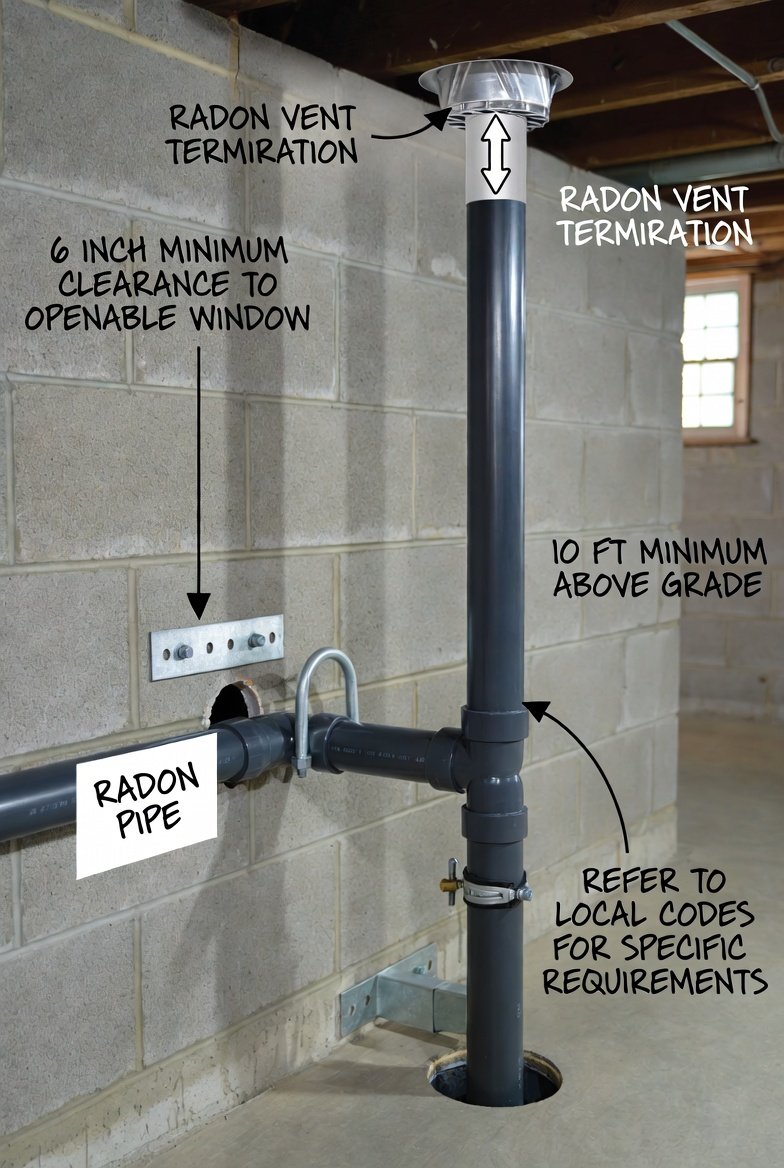
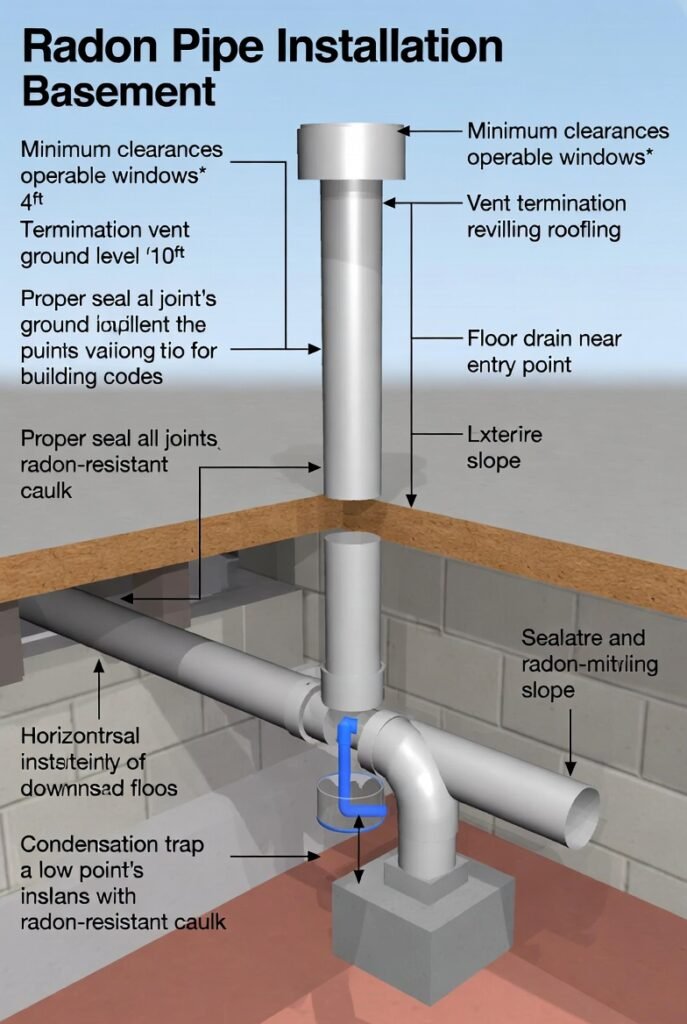
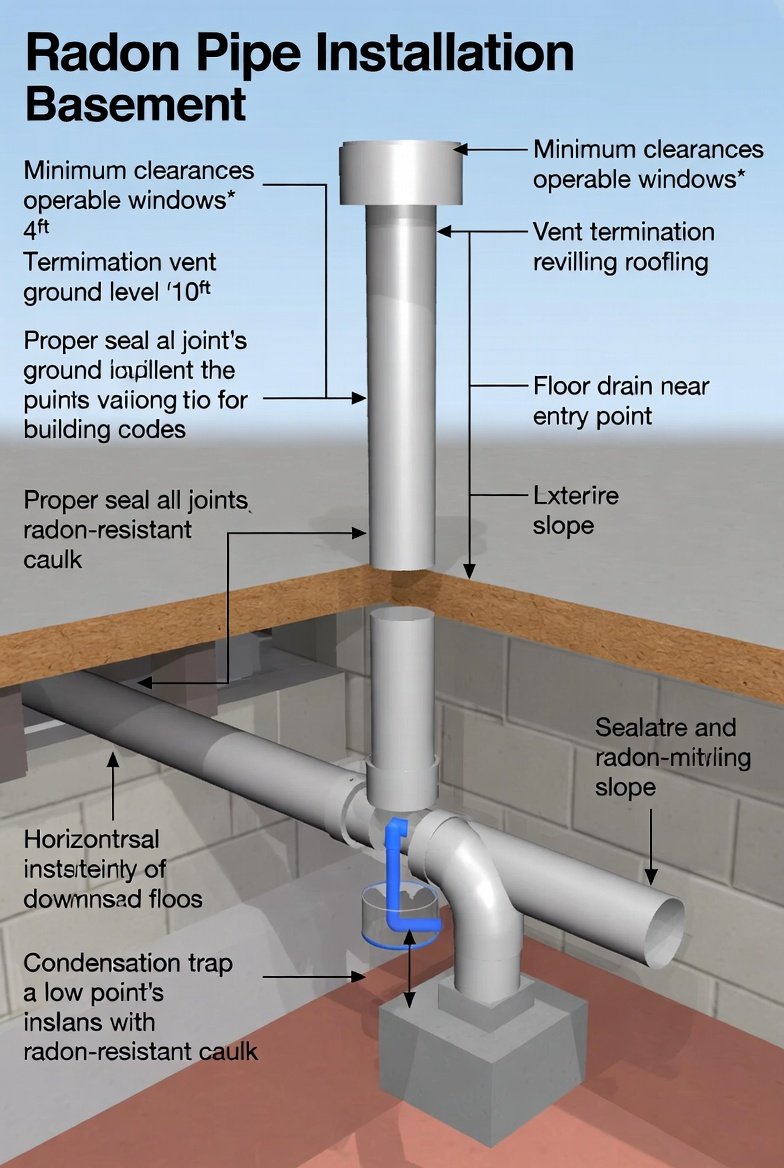
Foundation-Specific Routing
Basement Homes
Typical routing:
- Slab suction point
- Vertical basement wall riser
- Attic penetration
- Roof discharge
Visual Required: Basement routing diagram
Alt text: “Basement radon pipe installation with vertical riser and roof termination.”
Slab-on-Grade Homes
Often:
- Single suction point
• Vertical pipe inside garage wall
• Exterior fan mount
• Roof discharge
Less framing obstruction, often simpler routing.
Crawlspaces
Require:
- Sealed vapor barrier
• Sub-membrane suction
• Airtight membrane connections
• Vertical riser routed through framing
Crawlspace systems require more sealing discipline.
Pipe Diameter: 3” vs 4”
Diameter | Typical Use |
3″ PVC | Small footprint homes |
4″ PVC | Larger homes / high resistance soil |
Larger diameter reduces friction loss and improves airflow consistency.
Condensation & Freeze Risk (Climate Considerations)
Cold climates introduce risks:
- Warm air rising inside pipe condenses in attic
• Water droplets form
• Sagging pipe traps water
• Extreme cold can cause ice buildup
Mitigation strategies:
- Maintain slope
• Avoid long attic horizontal runs
• Insulate pipe in cold spaces
• Ensure roof flashing is sealed properly
Hot climates:
- UV degradation of exterior pipe
• Painting exterior pipe to match siding improves longevity
Code vs Best Practice (Comparison Table)
Category | Minimum Requirement | Best Practice |
Pipe Size | 3″ PVC allowed | 4″ for larger systems |
Support Spacing | 6 ft horiz | 4–5 ft preferred in long runs |
Termination | Above roof | High enough to avoid snow drift zones |
Labeling | Required | Visible in multiple locations |
Fan Location | Outside living space | Exterior or attic, accessible |
Radon mitigation guidance referenced in this guide aligns with ASTM E2121 and nationally recognized mitigation protocols.
Common Installation Failures (Inspection Gallery)
1. Sagging Pipe
Creates condensation trap → airflow restriction.
2. Termination Under Eaves
Exhaust can re-enter attic.
3. Too Many Elbows
Increases static pressure demand.
4. No Labeling
Pipe must be labeled “Radon Reduction System.”
5. Fan in Conditioned Space
Unsafe if leak develops.
Troubleshooting Radon Vent Issues
If radon levels remain elevated:
- Inspect pipe joints for separation
• Check for sagging or pooling
• Verify roof discharge is unobstructed
• Confirm fan is operating
• Ensure sump lid is airtight
Effectiveness context:
Installer Approval Checklist
Before approving an install:
✔ Vertical routing prioritized
✔ Minimal elbows
✔ Proper slope
✔ Proper support spacing
✔ Pipe labeled
✔ Manometer installed
✔ Termination height verified
✔ Roof flashing sealed
✔ Post-install radon test completed
Aesthetic & Resale Considerations
Professional installers often:
- Paint exterior pipe to match siding
• Route through closets or garages
• Avoid visible front façade placement
Clean routing reduces resale objections.
Radon Pipe Installation Cost Component
Pipe cost alone:
- $3–$6 per linear foot (PVC)
Pipe portion typically $100–$450 within total system install.
Full system cost context:
radon-system-installation
Is Radon Pipe Installation DIY-Friendly?
Basic slab routing may be possible for experienced DIYers.
However:
- Improper routing reduces performance
• Partial reduction may create false safety confidence
• Code violations affect resale
Professional installation is recommended for most homeowners.
Final Word
A radon pipe is not decoration.
It is a precision airflow component inside a pressure system designed to protect indoor air quality.
When routed vertically, supported correctly, sloped properly, and terminated above the roofline, it performs quietly and reliably for years.
When installed poorly, it becomes a silent failure point.