


Residential Indoor Air Quality Testing: What It Clarifies—and When It’s Not Necessary
Introduction: Why Homeowners Start Looking Into IAQ Testing
- Homeowners rarely research IAQ testing out of curiosity
- Common triggers include:
- Odors that won’t go away
- Headaches or irritation that feel worse at home
- Allergy symptoms improving outdoors
- Concerns after water damage, renovation, or moving
- Residential IAQ testing exists to:
- Reduce uncertainty
- Provide reassurance when appropriate
- When used at the wrong time:
- It creates confusion
- Leads to unnecessary expense
- Causes anxiety over numbers that don’t explain the issue
- This page explains:
- What residential IAQ testing really does
- What it can and can’t tell you
- How to decide whether testing helps—or can be skipped
What Residential Indoor Air Quality Testing Really Is
- Residential IAQ testing is a measurement and evaluation process
- Used in homes to understand airborne conditions affecting:
- Comfort
- Health perception
- Peace of mind
- Unlike commercial testing:
- It is rarely about documentation or compliance
- It is almost always about clarity
- Homeowners usually pursue testing to:
- Understand unexplained symptoms
- Confirm or rule out a suspected issue
- Decide whether action is justified
- Testing:
- Does not diagnose medical conditions
- Indoor air quality testing services
- Does not automatically mean something is wrong
- Results must be interpreted alongside:
- Home design
- Ventilation
- Daily use patterns
Common Triggers That Lead Homeowners to Consider Testing
- Residential testing is situational
- The trigger matters more than the test
- Common reasons include:
- Persistent odors with no clear source
- Ongoing allergy-like symptoms indoors
- Recent water damage or moisture concerns
- Post-renovation or new-construction worries
- Moving into an unfamiliar home
- Conflicting advice about whether air quality is “bad”
- Often the real question is:
- Does what’s in the air explain what I’m experiencing?
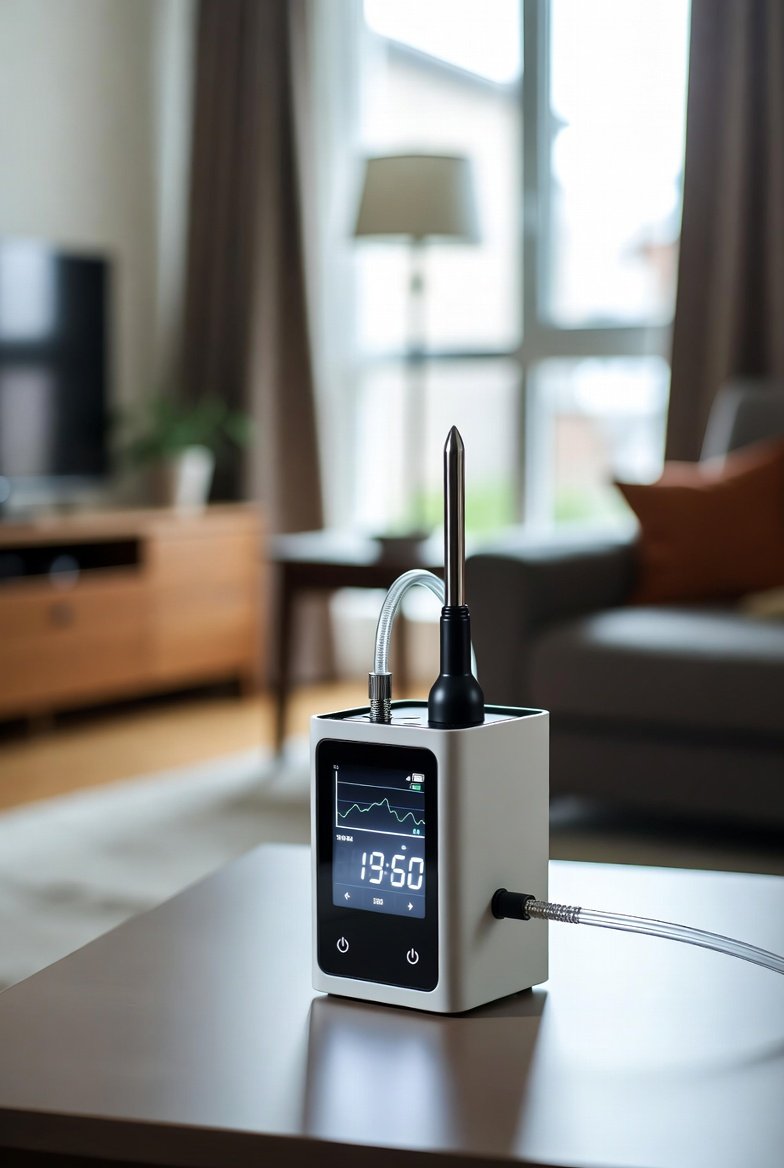
What Residential IAQ Testing Can Measure—and Why That Matters
- Residential testing can measure many indicators
- Each category answers a different question
- Results are not meaningful without context
Particulate Matter
- Used to understand:
- Dust levels
- Fine particles
- Filtration effectiveness
- PM2.5 / PM10
- Influenced by:
- Activity
- Outdoor infiltration
Chemical Indicators
- Used for:
- Odors
- Irritation
- Post-renovation concerns
- Volatile organic compounds (VOCs)
- Off-gassing from:
- Materials
- Furnishings
Combustion Byproducts
- Safety-related measurements
- Carbon monoxide (CO)
- Nitrogen dioxide (NO₂)
- Indicators of:
- Appliance issues
- Exhaust problems
Biological Indicators
- Used selectively and cautiously
- Airborne mold spore concentrations
- Limited bacterial indicators in specific cases
Comfort & Ventilation Metrics
- Used to understand air movement and balance
- Carbon dioxide (CO₂) as a ventilation proxy
- Temperature and relative humidity
- Testing is most useful when measurements are chosen to answer a specific question
Inspection vs Testing: The Most Important Residential Decision
- A common mistake:
- Jumping straight to testing
- Indoor air quality Inspection usually comes first when:
- Moisture, staining, or past leaks are visible
- Odors are room- or time-specific
- HVAC performance is inconsistent
- Symptoms appeared after a known event
- Testing makes sense when:
- Symptoms exist without visible causes
- Multiple occupants experience similar issues
- Confirmation is needed before deciding next steps
- Both are appropriate when:
- Initial fixes didn’t resolve the issue
- Inspection didn’t reveal a clear cause
- You want confirmation before stopping
Real-World Residential Examples
- Example 1
- Family experiencing headaches
- Inspection found unsealed attic access pulling dusty air
- Sealing resolved symptoms
- Testing was unnecessary
- Example 2
- Post-renovation irritation and chemical odors
- Inspection found no moisture or HVAC problems
- Targeted testing confirmed off-gassing was declining
- No remediation required
- Inspection often prevents unnecessary testing
- Testing, when used correctly, prevents unnecessary remediation
What Residential IAQ Testing Can—and Cannot—Tell You
Residential Testing Can:
- Identify elevated or unusual airborne conditions
- Confirm or rule out a suspected issue
- Help determine whether further action is reasonable
Residential Testing Cannot:
- Diagnose medical conditions
- Predict future air quality alone
- Prove a single cause for complex symptoms
- Replace moisture or ventilation evaluation
- Testing supports decisions—it doesn’t make them for you
When Residential Air Quality Testing Is Often Not Helpful
- Testing may add little value when:
- Comfort issues are clearly temperature- or humidity-related
- Construction or painting is ongoing
- A known issue has already been corrected
- The home is rarely occupied
- In these situations:
- Time
- Ventilation
- Basic fixes
- Often resolve concerns without testing
How to Interpret Results Without Overreacting
- Residential IAQ results must be read carefully
- Key principles:
- One elevated reading ≠ danger
- Background levels vary by season and location
- Exposure duration matters more than short-term spikes
- Trends matter more than snapshots
- Responsible interpretation focuses on relevance
- Many results support a “no action needed” conclusion
A Clear Stopping Point for Homeowners
- One of the best outcomes of testing is confirmation that nothing further is needed
- If results show:
- Typical conditions
- Stable humidity
- No unusual contaminants
- Stopping is often the correct decision
- Additional testing or products should only follow clear justification
- The goal:
- Reasonable confidence
- Not perfect air
Bottom Line
- Residential IAQ testing works best as a decision-support tool
- Used at the right time:
- It reduces uncertainty
- Provides reassurance
- Helps homeowners move forward confidently
- Used reflexively:
- It creates confusion
- Leads to unnecessary expense
- Knowing when to test—and when not to is what makes testing valuable